OpenRouter drops three AI providers and pulls 125 endpoints from zero data retention after prompt leaks
After Dragos researchers seeded AI prompts with tracking links and fake keys, OpenRouter off-boarded three inference providers and removed 125 endpoints from its no-storage list. What it means if your team sends data through AI routers.
- Author
 Umair Mateen
- Published
- Reading time
- 4 min
- Category
- AI
Ideas in this post
Tap one for a 5-second answer. Underlined words in the article work the same way.
0 of 4 understood
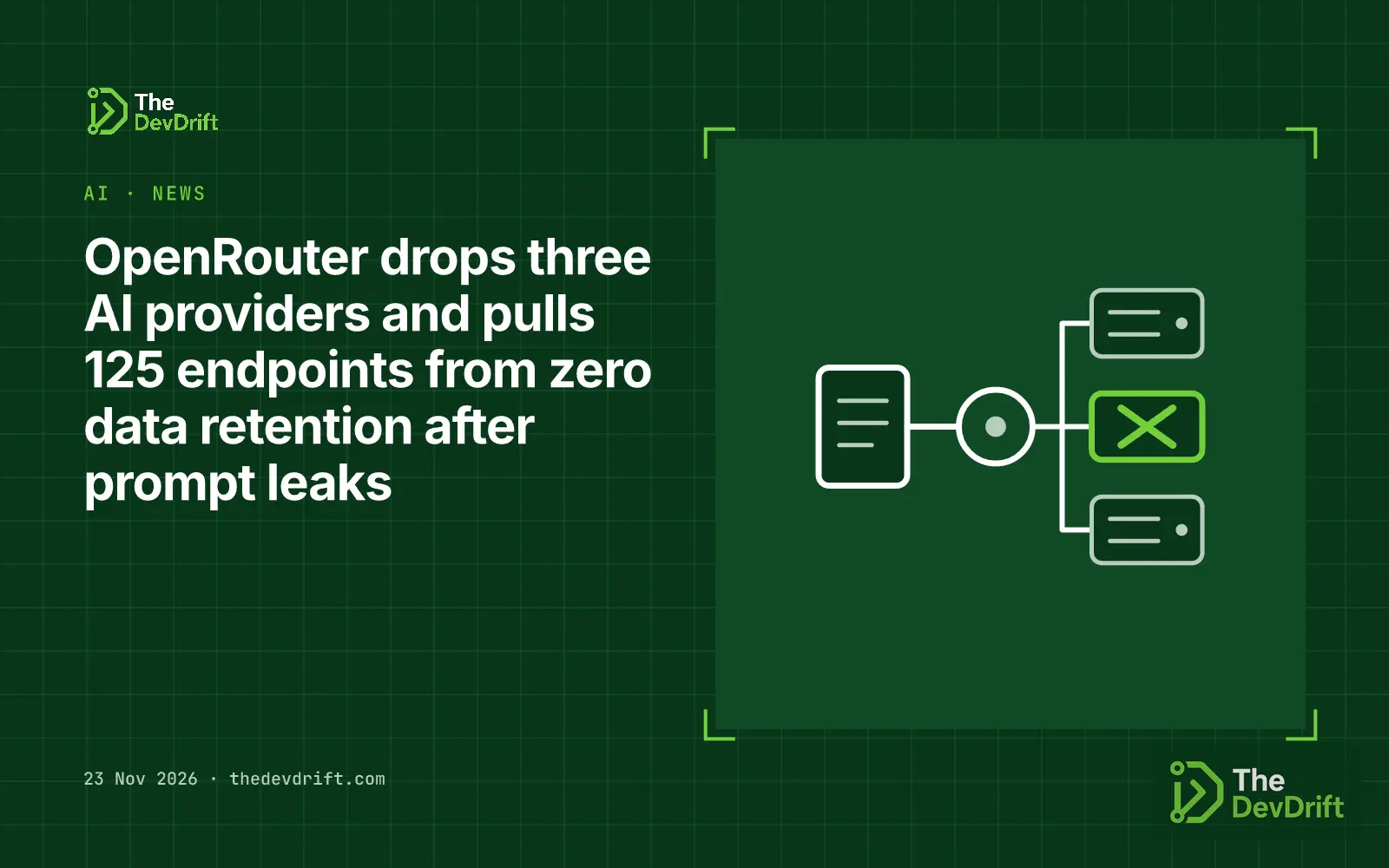
On 22 November 2026, OpenRouter, a popular service that routes AI requests to many model providers through one , said it had off-boarded three inference providers and removed 125 endpoints from its (ZDR) list. The move follows research from security firm Dragos showing that prompts sent to some AI providers were exposed or kept despite privacy settings.
What happened
Dragos published its findings on 19 November in a report by chief research officer HD Moore. Between July and November 2026 the team sent about two million prompts to widely used AI services. Each prompt carried a unique "canary": a tracking link or a fake cloud credential that should never be touched. If anyone later opened the link or tried the key, Dragos knew the prompt had been read somewhere it shouldn't have been.
According to the report, the canaries showed:
Quick check · Everyday ↔ real
The restaurant and the API, side by side
Switch between the two and see how each part lines up.
- You, the customer
- The menu
- Your order to the waiter
- The kitchen
- Your dish, or "sold out"
You order from the menu and the waiter brings back your dish, without you ever seeing the kitchen.
| Everyday | Real |
|---|---|
| You, the customer | The client (your app) |
| The menu | The documentation |
| Your order to the waiter | The request |
| The kitchen | The server |
| Your dish, or "sold out" | The response, or an error |
From the explainer What is an API? Explained with a waiter in a restaurant
- Evidence that data from at least three AI providers was exposed, with seeded prompts later used to reach Dragos test systems and decoy AWS accounts. The earliest incident dates to mid-July.
- Resellers on an marketplace viewing and keeping customer prompts through normal logging, with no hacking involved.
- Signs that providers did not honour privacy settings, including links opened months after a single request.
Dragos sums it up bluntly: "A privacy flag doesn't help when the attacker is already inside."
What OpenRouter did
OpenRouter says there was no breach of OpenRouter itself. It off-boarded three providers (the post does not name them), removed 125 endpoints from ZDR eligibility (both flagged providers and some taken off as a precaution), and notified customers who may have been affected. It says it is now running its own tests based on the researchers' method, checking network paths for forwarding to third parties, and will require assurances and validation before any removed endpoint gets ZDR status back.
The post links statements from four providers: Atlas Cloud, Novita, Phala and Together. Together AI's own disclosure, dated 21 November, is the most detailed. It says a subset of prompts sent to its service in June and July 2026, mainly for MiniMax M3, GLM-5.2 and Kimi K2.6, had been saved as test samples in a private Hugging Face repository. An AI coding agent committed the access credential for that repository to a public GitHub repo. An intruder downloaded the samples and tested credentials found inside them; five of those were Dragos canaries. Together says it has moved to short-lived credentials, now scans pull requests for secrets, made ZDR the default for new accounts, tightened its rules for coding agents, and will contact affected customers directly.
Who should care
Any business that sends customer data, contracts, code or internal documents to AI models through a router, marketplace or lower-cost host for open models. ZDR means a provider promises not to store prompts or responses after processing. This episode shows that promise is only as good as each provider's own security and honesty, and that you may not know which company actually processed a given request.
Limits and caveats
- OpenRouter does not say how long the exposure lasted or how many customers were affected, and it gives no specific customer steps beyond the notifications.
- Not every affected provider has posted publicly, according to OpenRouter.
- On OpenRouter's ZDR documentation, self-serve accounts that have not made a choice allow "safety retention" (storage to detect abuse) by default; enterprise accounts default to ZDR only. Tools such as web search are not covered by ZDR.
What to do this week
- If you use OpenRouter, check for a notification email, then open your privacy settings and turn on ZDR for the model groups you use. Developers can also send
"provider": {"zdr": true}with each request. - Pin the upstream providers you trust for sensitive workloads instead of letting the router pick the cheapest one.
- Assume any secret pasted into a prompt could leak. Strip API keys and passwords before data reaches a model, and rotate any that may have been sent.
- Ask each AI vendor in writing who processes your prompts, where, and how long they are kept.
- Check your own coding agents: Together's leak started with an agent committing a credential to a public repo. Turn on secret scanning for every repository.
The DevDrift helps teams build AI workflows that keep sensitive data out of prompts and route requests only to providers they have vetted.
Sources
You’ve read the news. Now understand it.
- Learn · 5 min · Everyday ↔ realWhat is an API? Explained with a waiter in a restaurantAn API is a set of rules that lets one program ask another for data or a task and get an answer back. Explained with a waiter carrying orders between you and the kitchen.Start in 5 seconds →
- Learn · 5 min · Myth or factWhat is zero data retention? Explained with a translator's shredderZero data retention is an AI provider's promise not to store your prompts or its answers after replying. Picture a translation office that shreds your letter once the reply is posted.Start in 5 seconds →
- Learn · 5 min · Everyday ↔ realTraining vs inference, explained with studying for an exam and sitting itTraining is when an AI model learns from huge amounts of data; inference is when the finished model answers your question. Explained with a student who studies for months, then sits the exam.Start in 5 seconds →
- Learn · 5 min · Side by sideWhat is serverless? Explained with taking a taxi instead of owning a carServerless means a cloud provider runs your code only when it is needed and bills you for that time. Like taking a taxi: you pay per trip, not for a car parked outside.Start in 5 seconds →