Anthropic's Enterprise Frontier Safeguards enter public beta, with a new trusted access API on Amazon Bedrock
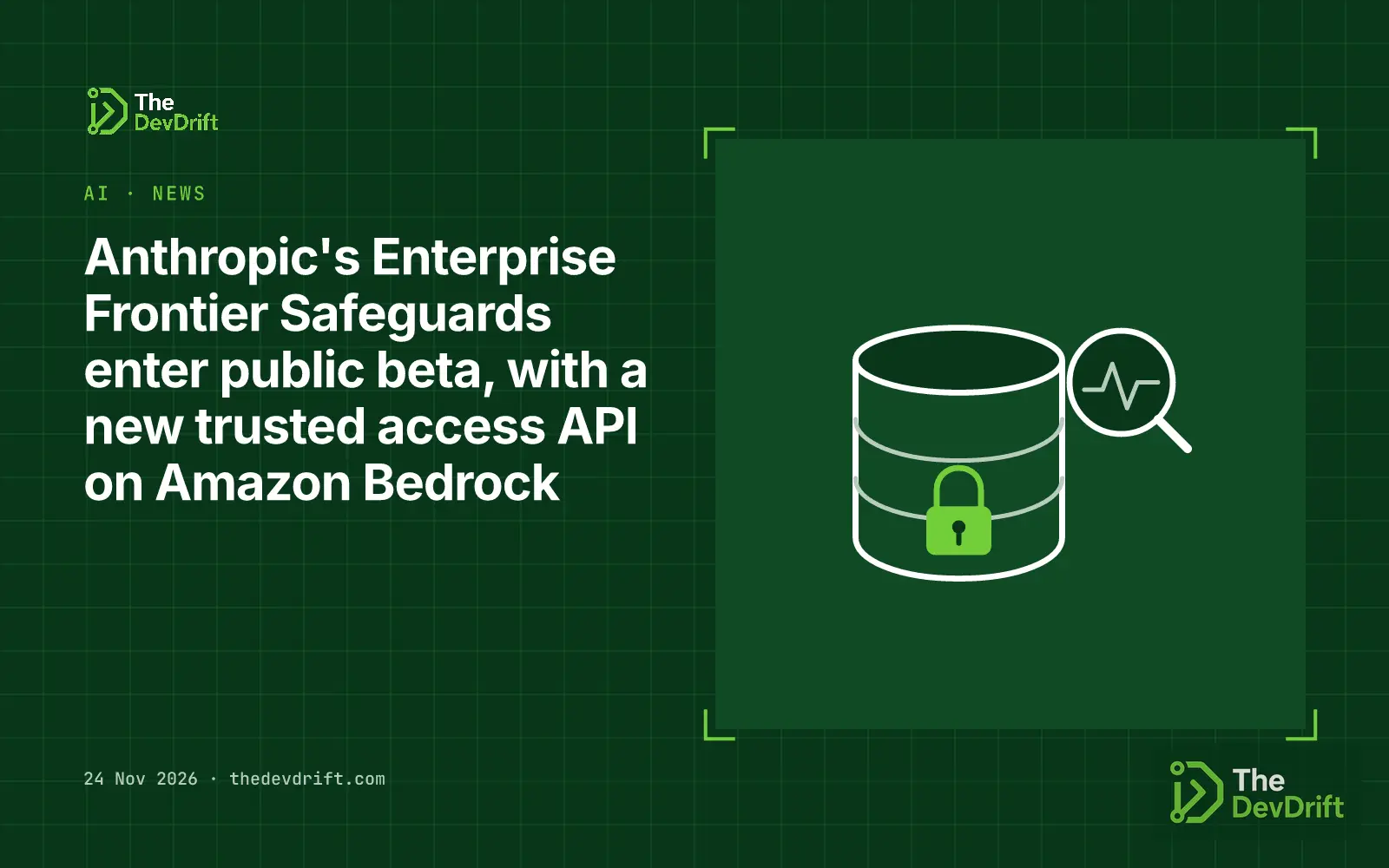
Enterprise Frontier Safeguards lets companies keep Claude prompts in their own cloud storage while automated checks look for misuse. It is in public beta on Claude Platform, Bedrock and Google Cloud.
- Author
 Umair Mateen
- Published
- Reading time
- 4 min
- Category
- AI
Ideas in this post
Tap one for a 5-second answer. Underlined words in the article work the same way.
0 of 4 understood
Anthropic put Enterprise Frontier Safeguards (EFS) into public beta on 23 November 2026. The same day, AWS launched the Amazon Bedrock Trusted Access API, a single place for companies to check eligibility for and enrol in programs like EFS.
What it actually does
Many companies use Claude under (ZDR), meaning the provider keeps no copy of prompts and answers. Anthropic's September post explains that, starting with Claude Fable 5, it introduced 30-day data retention to detect misuse (not for training). EFS is its answer for companies that can't accept that.
- Your storage, not theirs: prompts and answers are written to storage the customer controls (for example an Amazon S3 bucket with your own key), and Anthropic and the cloud provider keep no copy after that.
- Pattern checks: standard ZDR relies on screening single requests. EFS adds automated monitoring that looks for patterns across many requests; Anthropic's examples include attempts to build offensive cyber capabilities or signs of stolen credentials.
- Safety Cases: when the monitoring finds a risk, it creates a "Safety Case" for your team to review, readable from your storage or through an and connectable to a SIEM (security event logging tool). Anthropic says it receives only monitoring metadata, never the inputs or outputs, and that no staff at Anthropic or the cloud provider look at them.
Per the beta announcement, EFS is available on the Claude Platform, Claude Platform on AWS, Amazon Bedrock and Claude on Google Cloud, with Microsoft Foundry support coming soon. Anthropic's September post says it doesn't charge for EFS; your cloud provider bills the storage, reads, writes and key operations as usual.
Quick check · Everyday ↔ real
The restaurant and the API, side by side
Switch between the two and see how each part lines up.
- You, the customer
- The menu
- Your order to the waiter
- The kitchen
- Your dish, or "sold out"
You order from the menu and the waiter brings back your dish, without you ever seeing the kitchen.
| Everyday | Real |
|---|---|
| You, the customer | The client (your app) |
| The menu | The documentation |
| Your order to the waiter | The request |
| The kitchen | The server |
| Your dish, or "sold out" | The response, or an error |
From the explainer What is an API? Explained with a waiter in a restaurant
The Bedrock side
The AWS post says the Trusted Access API is . It shows, per account, organisation or project, whether you are eligible to enrol now or need approval first, and admins can control who enrols with IAM and service control policies. AWS lists two offerings in public preview: EFS, and Enterprise Data Controls (EDC), which runs the same automated monitoring but keeps data for up to 30 days in Amazon-managed storage, with no bucket or key to set up. Both cover Claude Fable and Claude Mythos, and Opus 5.5 and Sonnet 5.5 used through Anthropic's Cyber Verification Program.
Who should care
Banks, healthcare groups, law firms and other regulated businesses that want Anthropic's top models but have strict rules on where data lives. Anthropic says more than 100 customers helped design EFS. Smaller teams on standard plans are unlikely to need it.
Limits and caveats
- Eligibility: access is for eligible customers, who Anthropic says will be notified with instructions. On Bedrock you enrol through your AWS account team.
- ZDR switches off on Bedrock preview: AWS says joining the preview turns off zero data retention for the accounts you add. Check this before enrolling production accounts.
- Your bucket becomes critical: Bedrock "stops serving the covered models 24 hours after it loses access" to your key or bucket, so a broken key policy can take Claude offline.
- Per-region setup: storage is configured one AWS Region at a time; AWS doesn't list supported Regions in the post.
- EDC cases: during the preview, Safety Cases are not delivered for EDC.
What to do this week
- If you run Claude in a regulated setting, ask your Anthropic or AWS account team whether you are eligible and which option (EFS or EDC) fits your data rules.
- Decide who on your team will review Safety Cases and where they go (your SIEM or a ticket queue) before you switch anything on.
- On AWS, test in a non-production account first, and set alerts on the S3 bucket and KMS key so access problems are caught well within 24 hours.
- Have legal or compliance confirm that the retention model matches your contracts.
Sources
You’ve read the news. Now understand it.
- Learn · 5 min · Everyday ↔ realWhat is an API? Explained with a waiter in a restaurantAn API is a set of rules that lets one program ask another for data or a task and get an answer back. Explained with a waiter carrying orders between you and the kitchen.Start in 5 seconds →
- Learn · 5 min · Myth or factWhat is zero data retention? Explained with a translator's shredderZero data retention is an AI provider's promise not to store your prompts or its answers after replying. Picture a translation office that shreds your letter once the reply is posted.Start in 5 seconds →
- Learn · 5 min · Myth or factWhat is encryption? Explained with a sealed envelopeEncryption scrambles data with a secret key so only someone with the right key can read it. Explained as the difference between a postcard and a sealed envelope.Start in 5 seconds →
- Learn · 5 min · Side by sideWhat is general availability (GA)? Explained with a restaurant openingGeneral availability (GA) is when software is open to all customers and declared ready for real work, with support that preview and beta versions lack. Explained with a restaurant's soft opening and grand opening.Start in 5 seconds →