ChatGPT and Codex will share one usage allowance from December on Plus, Pro and Business
OpenAI says that starting in December, usage on Plus, Pro and Business plans will be shared across ChatGPT and Codex and measured in tokens, as Work's agent features move into the main ChatGPT app.
- Author
 Umair Mateen
- Published
- Reading time
- 3 min
- Category
- AI
Ideas in this post
Tap one for a 5-second answer. Underlined words in the article work the same way.
0 of 1 understood
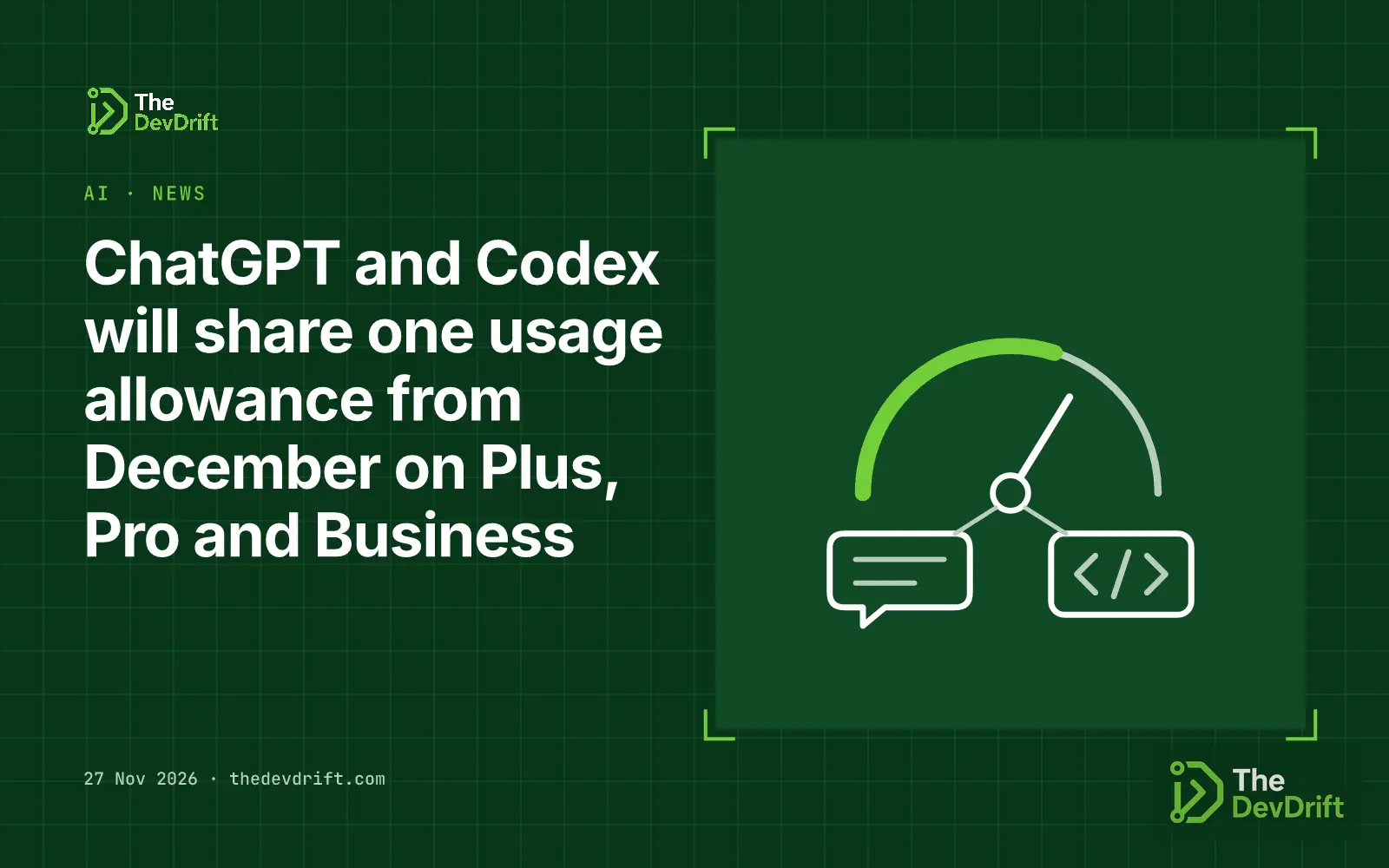
OpenAI has updated its help centre to say that starting in December, usage on Plus, Pro and Business plans will be shared across ChatGPT and Codex. OpenAI says this comes as it brings the agent features of Work into the main ChatGPT experience. A small group of users may see the change before December.
For context: ChatGPT is OpenAI's chat app, Work is its mode for longer, multi-step tasks, and Codex is its .
What changes
- One allowance: on Plus, Pro and Business, the usage you get will be shared across ChatGPT and Codex rather than counted separately.
- Measured in tokens: usage is counted in tokens (small chunks of text the model reads and writes). More advanced models and more complex tasks use more of the allowance.
- Quick chats are exempt: OpenAI says "Instant chat will not draw from your usage."
- Where to check: remaining combined usage and reset times show under Settings → Usage.
- At the limit: you can wait for the reset, upgrade your plan, or buy credits to keep using eligible features.
OpenAI says it expects most users won't have to wait for a reset more often than they do now.
Quick check · Myth or fact
AI agents: myth or fact?
Decide for yourself first, then tap each statement to check it.
0 of 3 checked
From the explainer What is an AI agent? Explained with an assistant you send on errands
What it means in practice
The practical effect is that your usage becomes one pot rather than several. If a developer spends a morning running long Codex jobs on an advanced model, that same person may have less left for a long ChatGPT task in the afternoon, and the other way round. Because usage is counted in tokens, the cost of a task depends on how much the model reads and writes and which model it uses, not simply on how many messages you send. A short question answered by instant chat costs nothing from the allowance; a long agent run over many files on a top model costs the most.
That makes model choice a budgeting decision for teams. Picking the most capable model for every task will use up the allowance faster than matching the model to the job.
Who should care
- Heavy users on Plus or Pro who use both ChatGPT agent tasks and Codex, since one now eats into the other.
- Business plan admins, whose developers using Codex and colleagues using ChatGPT for long tasks may hit limits on a different pattern than before.
- Finance owners deciding whether to buy credits or move people up a plan.
Limits and caveats
- The help page gives only "starting in December" with no exact day, and describes a staged rollout.
- It names Plus, Pro and Business. It does not describe changes for Free or Enterprise plans, so check with OpenAI if you are on one of those.
- The page doesn't publish token amounts per plan, so you can't yet calculate exactly how far an allowance goes.
What to do this week
- Open Settings → Usage on a few typical accounts to see current use and reset times before the switch.
- Identify who on your team uses Codex and ChatGPT agent tasks heavily; they are the most likely to notice.
- Encourage simple questions to go through instant chat, which OpenAI says won't count against usage.
- Agree a simple rule on when to pick an advanced model, and default to lighter ones for routine work.
- Decide ahead of time whether your policy at the limit is to wait, buy credits or upgrade, so people aren't stuck mid-task.