OpenAI and Cisco release Shirudo: open-source 'shields' that block a Linux flaw until you can patch
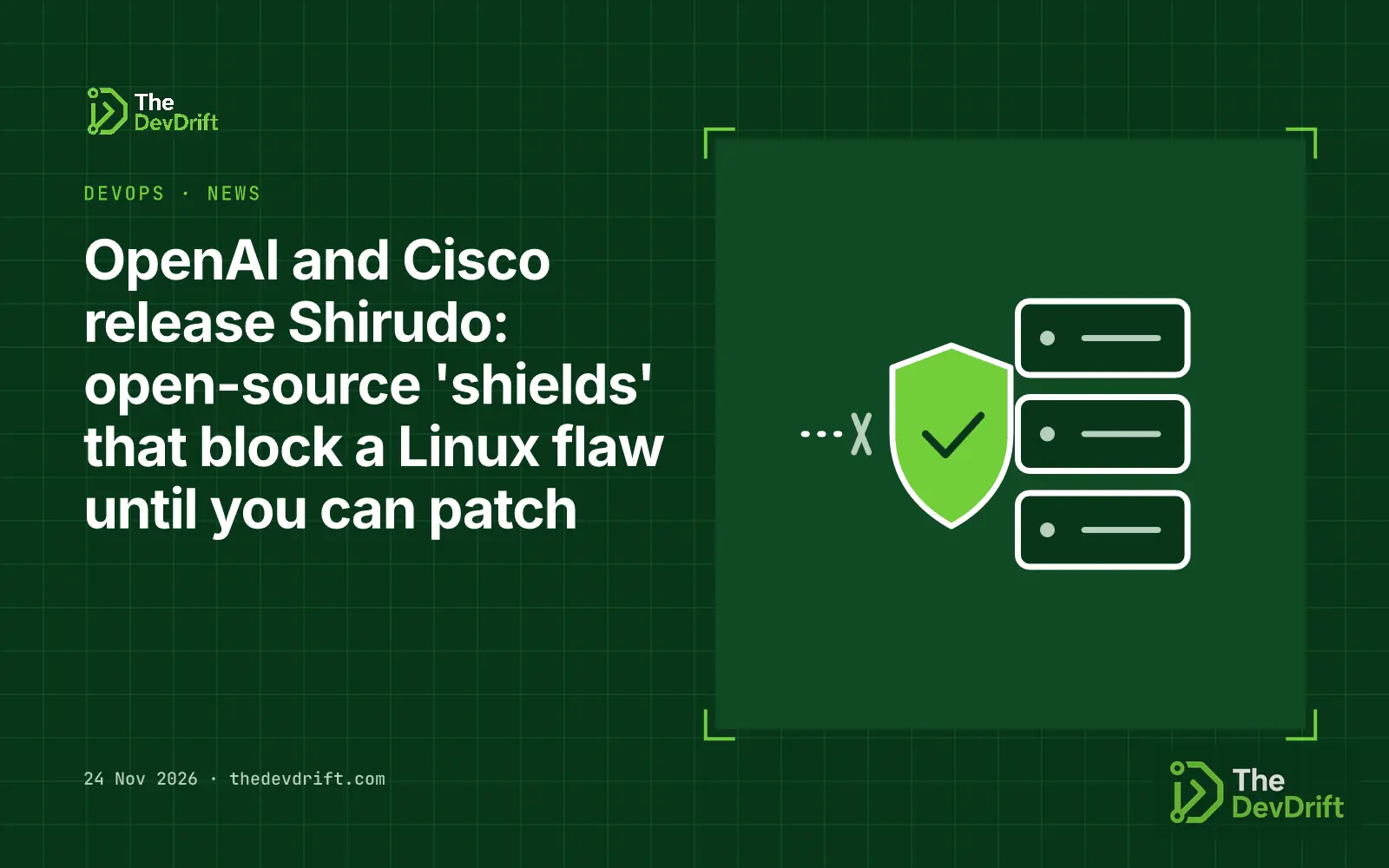
OpenAI and Cisco have open-sourced Shirudo, a Linux runtime that loads signed, temporary shields to block a vulnerable code path without restarting the service, buying time until the real patch ships.
- Author
 Umair Mateen
- Published
- Reading time
- 3 min
- Category
- DevOps
Ideas in this post
Tap one for a 5-second answer. Underlined words in the article work the same way.
0 of 4 understood
OpenAI and Cisco introduced Shirudo on 23 November 2026, an open-source tool for Linux servers that blocks a known vulnerable piece of code while you wait for, test and roll out the proper patch. The block is applied to the running system, so the affected service does not need a restart.
What it actually does
When a serious flaw is announced, there is usually a gap between "we know we are exposed" and "the fix is installed everywhere". Vendors need time to ship a patch, and your team needs time to test and deploy it. Attackers often move inside that gap.
Shirudo aims to narrow it with what the companies call shields: small, temporary rules that stop a specific vulnerable code path from being reached. Shields are built on eBPF, a feature of the Linux kernel that lets small, checked programs watch or control what the system does without changing the application itself. According to OpenAI's announcement:
Quick check · Myth or fact
AI agents: myth or fact?
Decide for yourself first, then tap each statement to check it.
0 of 3 checked
From the explainer What is an AI agent? Explained with an assistant you send on errands
- Shields are signed. Each one is cryptographically signed, and the kernel's own verifier checks it before it loads.
- Watch before you block. Operators can monitor what a proposed shield would do before enforcing it.
- A record of changes. A TPM (a hardware security chip) keeps a verifiable record of which shields were loaded or removed and when.
- People approve. Security teams decide which shields are deployed.
Where AI comes in
The link to OpenAI is that shields can be drafted by an AI . In a controlled demonstration, OpenAI says a shield written with its Codex agent blocked a Java4Shell exploit attempt against a running Elasticsearch service, with no restart, by adding an input check to Java's Base64 decoder. That is one lab test, not a track record; the value of any shield depends on it being reviewed by someone who understands the flaw and the service.
Who should care
Teams that run their own Linux servers and cannot always patch or restart quickly: infrastructure and platform teams, managed service providers, and companies with services where downtime is costly. OpenAI names developers, security researchers and infrastructure operators as the audience. If your applications run entirely on managed platforms where the provider patches the servers, this is less directly relevant.
Limits and caveats
- Not a patch. Shields are temporary mitigations. You still need to install the vendor fix.
- Linux only. It is a runtime for Linux systems.
- Open-source project, not a service. It is published on GitHub under the BSD 2-Clause licence, with the eBPF programs dual-licensed BSD and GPL. The announcement lists no pricing, support plan or commercial offering.
- New and early. There is no independent track record yet. A technical deep-dive webinar is scheduled for 15 December.
- A shield can break things. Blocking a code path can block legitimate traffic too, which is why monitoring a shield before enforcing it matters.
What to do this week
- Measure your current gap: for the last few critical advisories, how long between disclosure and the patch being live on every server?
- If that gap is days or weeks, have your infrastructure lead try Shirudo's quickstart in a test environment, not production.
- Decide who would approve a shield and how it would be removed once the patch is in. Write that down before you need it.
- Keep as the main process; treat shields as a bridge, not a replacement.
The DevDrift helps teams set up AI-assisted operations with and at each step.
Sources
You’ve read the news. Now understand it.
- Learn · 5 min · Myth or factWhat is an AI agent? Explained with an assistant you send on errandsAn AI agent takes a goal, plans the steps and carries them out with software tools, checking each result as it goes. Explained with an assistant you send on errands.Start in 5 seconds →
- Learn · 5 min · Put it in orderWhat is patching? Explained with a lock maker's safety noticeA security patch is a fix from a software maker for a known weakness. Like a lock maker's safety notice and replacement part, it only protects you once someone fits it.Start in 5 seconds →
- Learn · 5 min · What would you do?What is human-in-the-loop? Explained with a manager signing chequesHuman-in-the-loop means AI prepares the work but a person approves the important steps before they happen. Explained with a manager who signs every cheque before it goes out.Start in 5 seconds →
- Learn · 5 min · Myth or factWhat is an audit trail? Explained with a visitor logbookAn audit trail is a time-ordered record of who did what in a system, when and with what result. Explained with the visitor logbook at an office reception desk.Start in 5 seconds →