AWS Lambda previews durable workflows that run AI agent jobs in isolated MicroVMs
AWS has a developer preview that lets Lambda durable functions start, run and retry work inside isolated Lambda MicroVMs, aimed at agent-generated code, security scans and CI jobs. What it does, its limits and who should test it.
- Author
 Umair Mateen
- Published
- Reading time
- 5 min
- Category
- DevOps
Ideas in this post
Tap one for a 5-second answer. Underlined words in the article work the same way.
0 of 4 understood
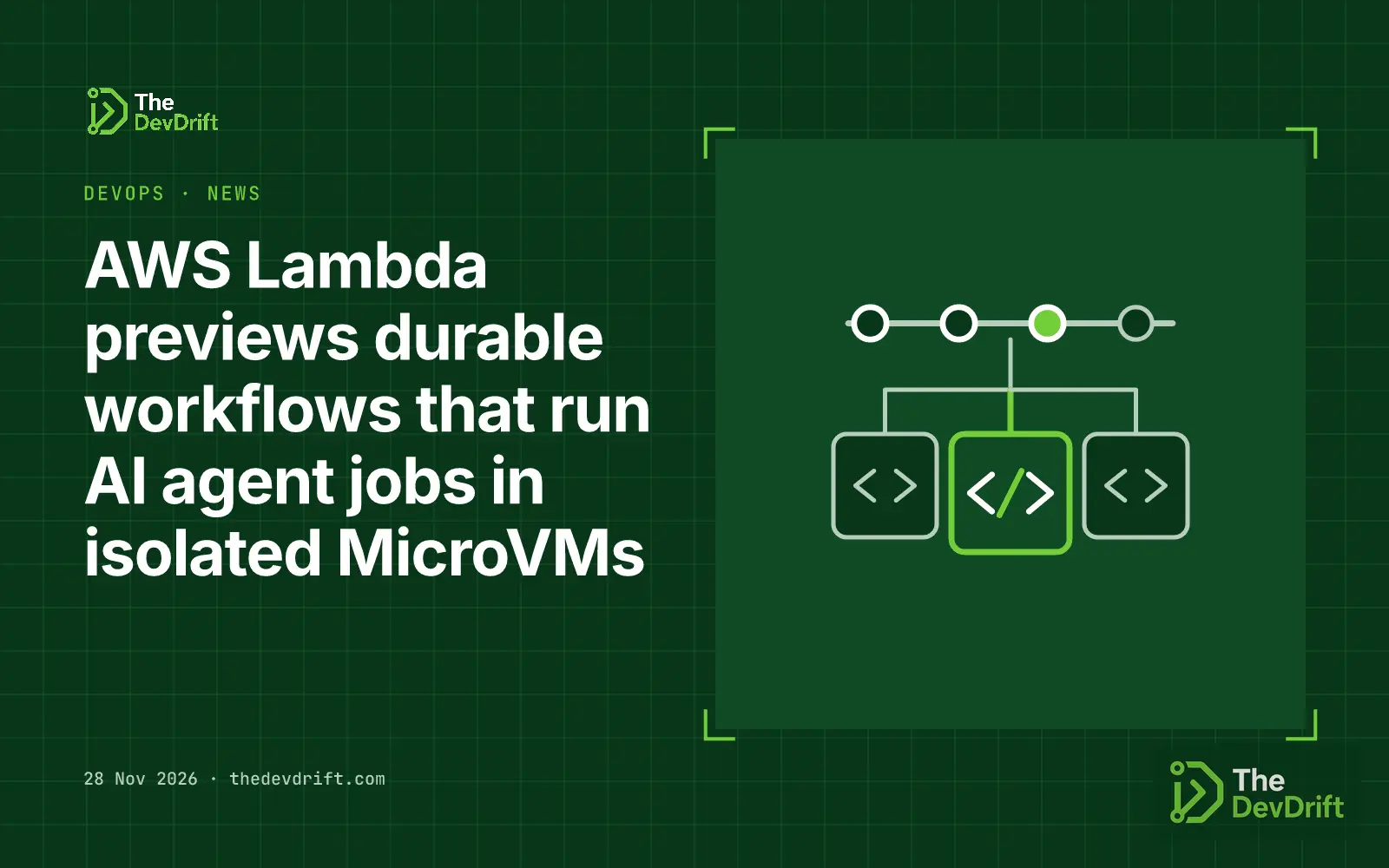
Amazon Web Services announced on 25 November 2026 a developer preview that lets Lambda durable functions orchestrate Lambda MicroVMs. In plain terms: one long-running workflow can now start isolated sandboxes, hand them tasks, retry what fails and shut them down, which is the shape of work AI and automated security scanners produce.
The two pieces being joined
Lambda MicroVMs launched in June. According to the AWS launch post, each one is a small , built on the same Firecracker technology that runs Lambda, with no kernel or resources shared between users. That makes it a safer place to run code written by a user or an AI model. A MicroVM keeps its state, can suspend itself when idle and resume later, and supports up to 8 hours of total runtime, with up to 16 vCPUs, 32 GB of memory and 32 GB of disk. AWS lists it in US East (N. Virginia, Ohio), US West (Oregon), Europe (Ireland) and Asia Pacific (Tokyo), on ARM64 only.
Lambda durable functions are workflows that save their progress as they go (checkpointing), so they can recover from a failure without starting over. The announcement says they can run for up to one year, and AWS's re:Invent 2026 serverless guide describes sessions on using them for waits that need a .
Quick check · Side by side
Own the car or call a taxi?
Tap what matters to you (pick one or more) and see which option fits.
Own a car (your own server)
- You pay for the server even when it sits idle.
- A steady monthly price can work out cheaper.
- Your team keeps the server patched and running.
- A job can run for as long as it needs.
- You must add capacity yourself in time.
- Easier: a server is a server.
Take a taxi (serverless)
- You pay only while your code runs.
- Paying per run can add up for constant heavy use.
- The provider handles the machines for you.
- Each run has a time limit set by the provider.
- The platform adds copies automatically.
- Harder: each provider has its own triggers and tools.
Pick what matters to you and the better fit lights up.
From the explainer What is serverless? Explained with taking a taxi instead of owning a car
What the preview adds
The new extension for the AWS Durable Execution SDK lets a durable function take charge of MicroVMs. Per the announcement:
- Lifecycle handled for you. The durable function manages each MicroVM's lifecycle and runs every task as a durable step. It checkpoints progress, retries failed tasks and refreshes the MicroVM's access tokens as needed.
- One-off tasks or shared sessions. A task can run in its own MicroVM, or several tasks can run in a MicroVM session where they share the same files and memory, which suits an agent that builds up a working folder step by step.
- Parallel sandboxes. One durable function can drive several MicroVMs at once.
- Event triggers. Workflows can start from Amazon SQS queues or Amazon EventBridge events.
- A worker library. An optional library inside the MicroVM image receives tasks, sends heartbeats and reports results back.
It works with TypeScript and Python, and is available in every AWS region that offers both durable functions and MicroVMs. AWS names software factories, security scanners and CI/CD jobs that run untrusted or agent-generated code as the intended uses.
Who should care
Teams building AI agents that write and run code, run tests or process files for customers. Today, many such teams build their own glue: a queue, a database of job states, retry logic and cleanup scripts to make sure sandboxes don't run (and bill) forever. This preview moves that glue into AWS's own workflow layer. It is also relevant if you run scanning or build jobs on code you don't fully trust, such as pull requests from outside contributors.
There is a related pattern already documented: AWS has a guide on using Lambda MicroVMs as the sandbox for Claude Managed Agents, where Anthropic runs the agent and model while each session's tool calls run in its own MicroVM in your AWS account. The new extension is a separate, general-purpose way to coordinate MicroVMs from your own workflows.
Limits and caveats
- Preview only. AWS is direct about this: "Developer preview features may change, so do not use them for production workloads."
- No pricing in the announcement. Neither the announcement nor the MicroVM launch post lists per-unit rates; MicroVM charges are on the Lambda pricing page. Check them before estimating costs, especially for long sessions.
- Two different time limits. The workflow can last up to a year, but each MicroVM has an 8-hour runtime ceiling, so long jobs need to be split across sandboxes.
- Limited regions and chips. MicroVMs are in five regions and ARM64 only, which matters if your data must stay in a specific EU country outside Ireland, or your tools only run on x86.
- Timing. AWS re:Invent runs 30 November to 4 December, so more serverless and agent announcements are likely next week; the details of this preview may change with them.
What to do this week
- If you run agent or scanning jobs on AWS, list where you currently hand-build retries, job tracking and sandbox cleanup. Those are the parts this preview would replace.
- Have one engineer try the sample app from the announcement in a test account, with a small TypeScript or Python job, and note what breaks.
- Check the Lambda pricing page for MicroVM rates and model a typical job (how many sandboxes, how long each runs) before committing.
- Confirm your region and CPU architecture are supported, and keep production on your current setup until AWS moves this out of preview.
The DevDrift helps teams put AI agents into their workflows with sandboxing, approvals and audit trails.
Sources
- AWS What's New: AWS Lambda now supports orchestrating MicroVMs with Lambda durable functions
- AWS News Blog: Run isolated sandboxes with full lifecycle control: AWS Lambda introduces MicroVMs
- AWS Compute Blog: Your serverless attendee's guide to AWS re:Invent 2026
- AWS Lambda docs: Using Lambda MicroVMs as a sandbox for Claude Managed Agents
You’ve read the news. Now understand it.
- Learn · 5 min · Side by sideWhat is serverless? Explained with taking a taxi instead of owning a carServerless means a cloud provider runs your code only when it is needed and bills you for that time. Like taking a taxi: you pay per trip, not for a car parked outside.Start in 5 seconds →
- Learn · 5 min · Myth or factWhat is an AI agent? Explained with an assistant you send on errandsAn AI agent takes a goal, plans the steps and carries them out with software tools, checking each result as it goes. Explained with an assistant you send on errands.Start in 5 seconds →
- Learn · 5 min · Side by sideWhat is a virtual machine? Explained with flats in one buildingA virtual machine is a whole computer made of software, with its own operating system, running on a share of a real server. Like a separate flat inside one building.Start in 5 seconds →
- Learn · 5 min · What would you do?What is human-in-the-loop? Explained with a manager signing chequesHuman-in-the-loop means AI prepares the work but a person approves the important steps before they happen. Explained with a manager who signs every cheque before it goes out.Start in 5 seconds →