AWS's Strands Decider v2: small open models that make an agent's routine choices for less
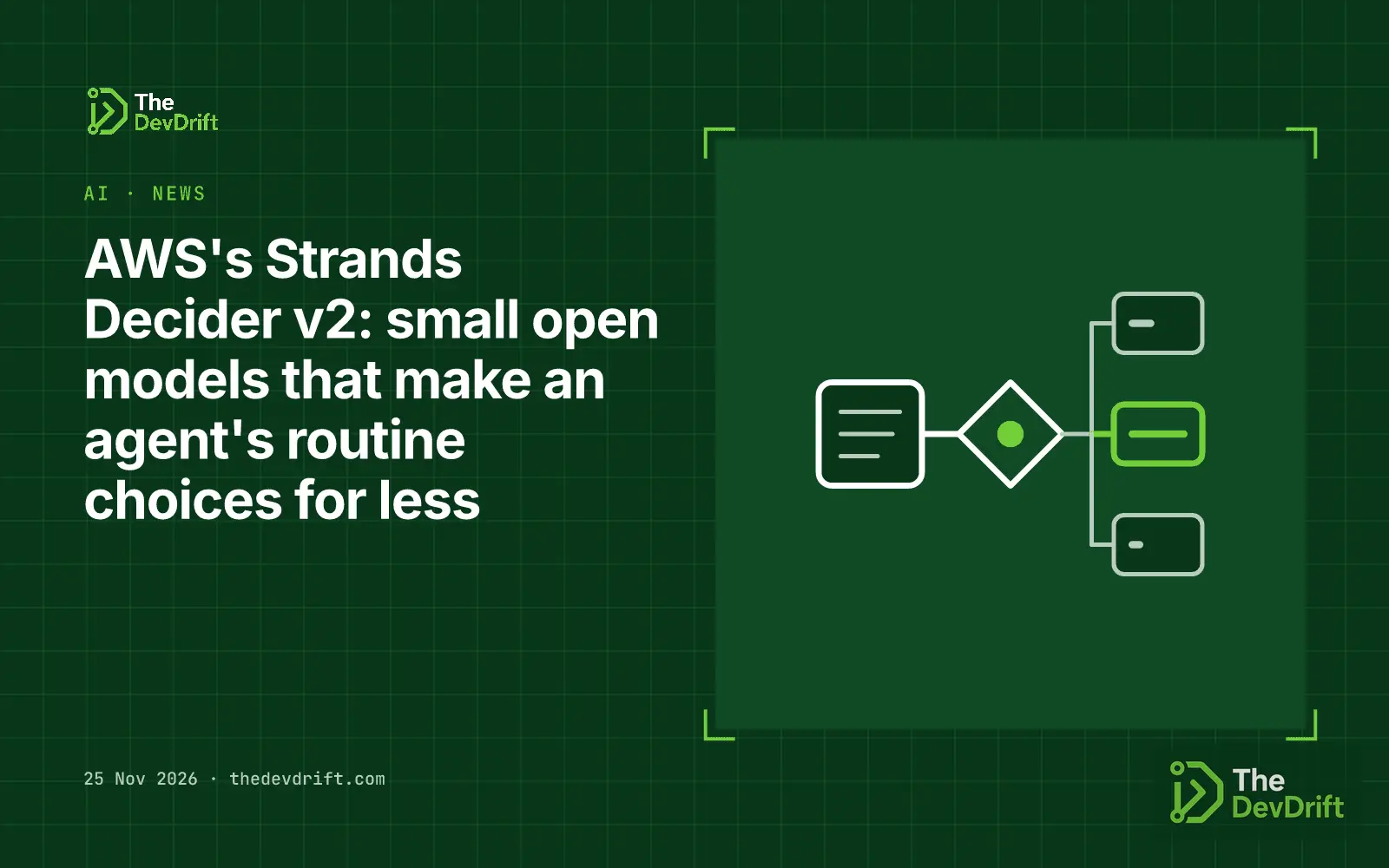
The AWS-backed Strands Agents project released Decider v2: five open models built on Gemma 4 that pick from a fixed list of options and return a confidence score, instead of writing text.
- Author
 Umair Mateen
- Published
- Reading time
- 4 min
- Category
- AI
Ideas in this post
Tap one for a 5-second answer. Underlined words in the article work the same way.
0 of 4 understood
The Strands Agents project, the open-source agent toolkit published by Amazon Web Services, released Strands Decider v2 on 23 November 2026. It is a family of five small-to-mid-sized open models that do one job: given a situation and a fixed list of options, pick one and say how sure they are.
What it actually does
Most make many small choices along the way: which team should get this ticket, which tool to call next, whether a request needs a bigger model. Today many teams send each of those choices to a large, general model that writes a text answer. Decider is built for that narrower case. The team calls it a "system one model", borrowing the psychology term for fast, intuitive judgement.
- Five sizes: the announcement lists five models built on Google's open Gemma 4, from E2B to 31B (E2B, E4B, 12B, 26B-A4B and 31B), released under the Apache-2.0 licence.
- Answers, not text: per the quickstart, Decider returns the selected option, a probability for every option and a confidence score. In the docs' sample, a support message about failed payouts is routed to "technical" with about 80% probability.
- Images too: the quickstart says the v2 models accept images directly, for example a screenshot, with no extra setup.
- Where it runs: weights are on Hugging Face and the code, training recipe and evaluations are on GitHub. You install it with pip and can run it as a local HTTP service.
According to the announcement, the models were trained on 17.5 million examples. On six public text , the largest v2 model averages 82.1, up from 70.0 for the biggest v1 model; the post also reports 90.1 on image tasks and 70.2 on video tasks. These are the project's own figures, not independent tests.
Quick check · Myth or fact
AI agents: myth or fact?
Decide for yourself first, then tap each statement to check it.
0 of 3 checked
From the explainer What is an AI agent? Explained with an assistant you send on errands
Why business owners and team leads should care
If your team is building agents, a large share of the bill can come from routine calls. The announcement says one of Amazon's largest internal ticketing systems swapped Claude Sonnet 4.6 for the earlier Decider version for ticket labelling, cutting cost by 98% and making each call 78% faster. That is Amazon's own report about v1, so treat it as an example of the pattern rather than a promise for your workload.
Because the models are open and come in small sizes, a team can run them on its own hardware or cloud account, which keeps those routine decisions, and the data in them, inside its own systems.
On the same day the project also added native support for Claude Code, Codex and Kiro CLI to Strands Box, its open-source sandbox that contains a coding agent on your machine and checks what it does against a policy.
Limits and caveats
- Fixed choices only. Decider picks from options you supply. It does not write replies, summaries or code, so it sits beside a general model, not in place of it.
- You run it. This is a set of open models and tools, not a managed service with a price list. Hosting, monitoring and updates are your job.
- Vendor benchmarks. The scores and the Amazon savings come from the project itself. Test on your own data before switching anything.
- Labs status. The docs sit under the project's "labs" section, which signals early-stage tooling.
What to do this week
- List the decisions your agents or workflows make again and again that have a short, known set of answers (routing, tagging, yes/no checks).
- Pull a few hundred past examples with the correct answers and run the smallest Decider model against them using the quickstart.
- Compare accuracy, cost and speed with what you use now, and decide on a confidence level below which a person or a larger model takes over.
- If your developers already use Claude Code or Codex, look at Strands Box as a way to limit what those agents can do on their machines.
The DevDrift helps teams put AI agents into everyday workflows with sensible routing, approvals and .
Sources
You’ve read the news. Now understand it.
- Learn · 5 min · Myth or factWhat is an AI agent? Explained with an assistant you send on errandsAn AI agent takes a goal, plans the steps and carries them out with software tools, checking each result as it goes. Explained with an assistant you send on errands.Start in 5 seconds →
- Learn · 5 min · Myth or factWhat are AI benchmarks? Explained with a school examAn AI benchmark is a standard test: the same questions and the same marking for every model, so scores can be compared. Explained with a school exam that every student sits.Start in 5 seconds →
- Learn · 5 min · Try the dialWhat is AI classification? Explained with a post roomAI classification is when a model sorts each item, like an email or a document, into one of a fixed list of categories, with a score for how sure it is. Think of a post room sorter filling pigeonholes.Start in 5 seconds →
- Learn · 5 min · Myth or factWhat is an audit trail? Explained with a visitor logbookAn audit trail is a time-ordered record of who did what in a system, when and with what result. Explained with the visitor logbook at an office reception desk.Start in 5 seconds →