Google Workspace makes AI agents use MCP: REST access for agents ends 1 February 2027
Google's Workspace MCP servers and CLI are now generally available, and AI agents must use them instead of the REST APIs from 1 February 2027, with new admin controls and usage tiers.
- Author
 Umair Mateen
- Published
- Reading time
- 5 min
- Category
- AI
Ideas in this post
Tap one for a 5-second answer. Underlined words in the article work the same way.
0 of 4 understood
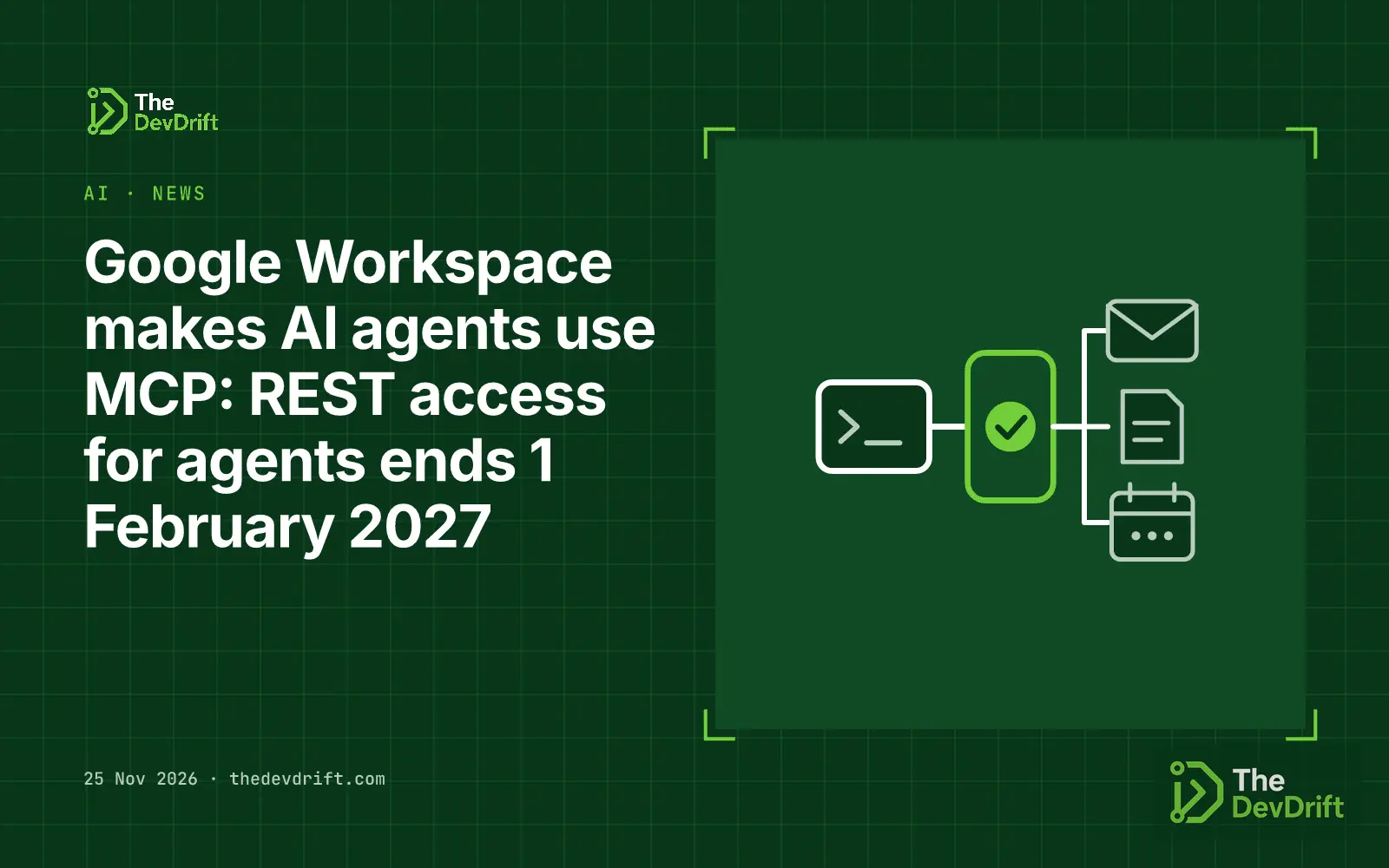
Google has made its Workspace servers and the official Workspace command-line tool (CLI) , and set a deadline: from 1 February 2027, that read or act on Gmail, Drive, Docs and other Workspace data must connect through them rather than calling Workspace's regular REST directly. The change was announced on the Workspace Updates blog on 24 November 2026, with a companion Google Cloud blog post on 25 November.
MCP (Model Context Protocol) is an open standard for plugging tools and data into AI models. A REST API is the ordinary web interface apps have used to talk to Workspace for years.
What Google announced
- MCP servers, now GA: dedicated servers for Gmail, Google Drive, Docs, Sheets, Slides, Calendar, Chat and Tasks, with Keep listed as coming soon.
- Workspace CLI, now GA: aimed at agents that run in a terminal, a virtual machine or a container, with scoped sign-in and structured output.
- Agents must identify themselves: developers are asked to mark the OAuth client an agent uses as an AI-powered agent, and to keep a separate client for ordinary, non-agent features. Admins can then manage agents in the Admin console much like any other connected app.
- New terms: a Workspace AI Tools Addendum. The Cloud post says it rules out model training on the data, permanent raw storage, extended retention of derived data and scraping, and that data must be removed when a user disconnects.
What it means for agents versus normal apps
The rule is about agents. The Cloud post states that traditional apps keep running on the REST APIs. What changes is that agent traffic goes through MCP or the CLI, where Google says each call is checked against the organisation's Workspace permissions, data-loss-prevention (DLP) rules and classification labels. In Google's words, "a valid token is no longer enough".
Quick check · Myth or fact
MCP: myth or fact?
Decide for yourself first, then tap each statement to check it.
0 of 3 checked
From the explainer What is MCP? Explained with an office of service counters
According to the Cloud post, the MCP servers and CLI ask the user to confirm before an agent sends email, changes Drive sharing or makes bulk edits. The Workspace post adds that admins can set their own confirmation rules for sensitive actions in third-party AI tools, such as reading external files or sharing data, while routine steps like creating a draft stay unprompted.
Usage tiers and billing
Google is also standardising usage limits, starting with Gmail, Drive and Calendar and extending to other access methods in the coming months:
- Standard tier: no charge, with published rate limits. Google says over 99% of active developers already fit inside it.
- Scaled tier: for projects needing higher quotas. From 1 April 2027, usage above the daily free allowance is billed. Google's post does not list prices.
- Internal projects: a Workspace admin can mark a project used only inside the organisation as internal, so its higher limits stay included in the Workspace subscription.
Projects with raised limits that are neither switched to Scaled nor marked internal by 1 April 2027 drop to Standard limits and may be throttled.
Admin controls, now and later
The Workspace post says the admin agent controls, the usage dashboard and Scaled tier selection roll out to Rapid Release and Scheduled Release domains over about two weeks. Admins get settings under Security > API Controls to manage access for external AI tools, the MCP servers, the CLI and the APIs, plus confirmation rules and agent audit logs. Existing DLP rules apply to agent use automatically.
Some controls are still to come. Google says users will be able to see agent activity and revoke an agent's access themselves, and that "AI access restrictions" will let admins and users block agents from Gmail messages and specific Drive files and folders. More granular agent policies are promised over the coming months, without dates.
Who should care
- Teams that built AI tools on Workspace data, such as an assistant that reads Gmail or files documents in Drive through the REST APIs. These need moving to the MCP servers or CLI before 1 February 2027.
- Workspace admins, who now have a place to see and limit which agents touch company email and files.
- Buyers of third-party AI tools that connect to Google Workspace. It is worth asking vendors when they will switch and how they handle the new terms.
What to do this week
- List every AI tool or script in your organisation that connects to Gmail, Drive, Calendar or other Workspace apps, and note which ones act as agents.
- Ask your developers or vendors for a migration plan to the Workspace MCP servers or CLI ahead of 1 February 2027.
- Once the controls appear in your Admin console, review connected apps and agents under Security > API Controls and decide which actions should require a person's confirmation.
- Check the new usage dashboard. If a project exceeds Standard limits, decide before 1 April 2027 whether to mark it internal or move it to the paid Scaled tier.
- Read the AI Tools Addendum, especially the parts on storing and deleting data.
The DevDrift helps teams connect AI agents to their business tools with approvals and audit trails built in.
Sources
You’ve read the news. Now understand it.
- Learn · 6 min · Myth or factWhat is MCP? Explained with an office of service countersMCP (Model Context Protocol) is one shared way for AI assistants to connect to other software and use it with your permission. Explained with an office where every department takes the same request slip.Start in 5 seconds →
- Learn · 5 min · Side by sideWhat is general availability (GA)? Explained with a restaurant openingGeneral availability (GA) is when software is open to all customers and declared ready for real work, with support that preview and beta versions lack. Explained with a restaurant's soft opening and grand opening.Start in 5 seconds →
- Learn · 5 min · Myth or factWhat is an AI agent? Explained with an assistant you send on errandsAn AI agent takes a goal, plans the steps and carries them out with software tools, checking each result as it goes. Explained with an assistant you send on errands.Start in 5 seconds →
- Learn · 5 min · Everyday ↔ realWhat is an API? Explained with a waiter in a restaurantAn API is a set of rules that lets one program ask another for data or a task and get an answer back. Explained with a waiter carrying orders between you and the kitchen.Start in 5 seconds →