OpenAI releases GPT-Rosalind-6 for life sciences research, to approved customers only
OpenAI's new life sciences model, built on GPT-6 Astra, launched on 30 October for approved organisations only. What it does, who can get it, what OpenAI's own safety report says, and what biotech teams should do.
- Author
 Umair Mateen
- Published
- Reading time
- 4 min
- Category
- AI
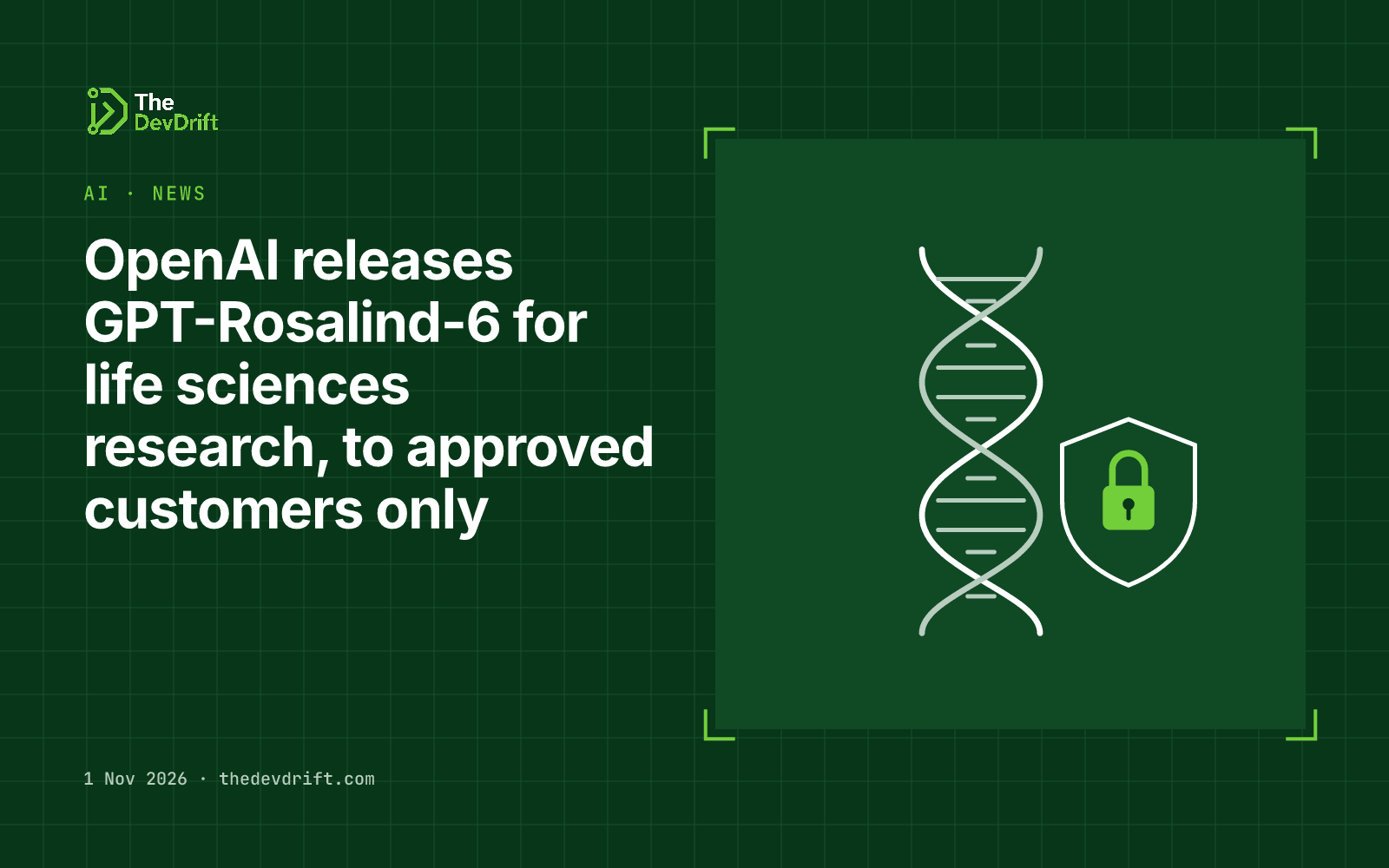
On 30 October 2026, OpenAI released a new version of its life sciences model, built for biological reasoning and the use of scientific tools in complex research. OpenAI's system card addendum calls it GPT-Rosalind-6 and describes it as a reasoning model for biology, drug discovery and translational medicine (turning lab findings into treatments). It is not generally available: access is limited to organisations OpenAI approves through its trusted-access programme.
What it is
GPT-Rosalind-6 is not a separately trained model. OpenAI says it "uses the same weights as GPT-6 Astra", its flagship reasoning model, and that it did not add training data or do extra post-training for this release. What differs is how it is tuned to behave and who is allowed to use it. OpenAI says it is set up to be more helpful on legitimate advanced biology, including some topics that could be misused, while still refusing requests that would meaningfully help someone build a biological weapon.
On OpenAI's own life sciences tests, the new version scores well above the previous GPT-Rosalind-5.5. For example, OpenAI reports a mean score of 49.6% versus 28.9% on its MedChemBench v7 medicinal chemistry test, and 61.3% versus 44.0% on LifeSciBench Gold. OpenAI cautions that some comparisons are not like-for-like, because benchmark versions and settings differ between runs, and that its tests were deliberately built around tasks earlier models handled poorly.
Who can get it
According to the system card, access is offered as GPT-Rosalind-6 Research to qualified scientists, research institutes, companies and government partners. OpenAI reviews each applicant's intended use, security controls and governance before granting access. Non-government applicants go through business verification and compliance screening, and government access follows a separate route for biosecurity, public health and biodefence work. OpenAI says eligibility has not been widened beyond what it announced before, such as its academic plan.
The system card does not list pricing, and our sources did not say which OpenAI products (API, ChatGPT or Codex) expose the model. Approved customers should expect that detail in their onboarding.
What the safety report says
OpenAI rates the model "High" for biological and chemical risk, below its "Critical" level, and says none of its Critical-level biology evaluations reached their thresholds. In cybersecurity, it says it treats GPT-Rosalind-6 as Critical, and keeps real-time blocking of risky cyber requests along with a more cautious refusal boundary.
The safeguards OpenAI lists include:
- the access review described above;
- a requirement that approved enterprise customers give the model only the access it needs and have qualified people review its outputs;
- monitoring, enforcement and contractual security requirements.
OpenAI is open that a few safety measures came out slightly worse than for the parent model. One example is how often the model engaged with instructions embedded in messages from outside agents: 2.5% versus 0.0%. That matters most for teams planning to connect the model to automated pipelines or other agents.
Who should care
- Biotech, pharma and contract research organisations already using AI in early discovery, protein work or literature review.
- University and institute labs, which may already qualify through OpenAI's academic route.
- Everyone else mostly as a signal: frontier labs are now releasing their most capable domain models through vetted access rather than to the public, and that pattern is likely to spread to other sensitive fields.
What to do this week
- If you are a life sciences team, read the system card addendum before applying. It sets out what OpenAI will expect from you on security and governance.
- Get your controls written down. OpenAI's review asks about intended use, security and governance. A one-page description of who will use the model, on what data, with what human review, will speed up any application.
- Plan human review into the workflow. OpenAI requires qualified people to review outputs. Budget expert time for this from day one.
- Be careful with agent setups. Given the external-agent result above, keep the model's tool access narrow and avoid feeding it unvetted content from other automated systems.
- Test it on your own problems. Benchmarks built by the vendor are a starting point. Run a small, well-defined pilot against your existing process before committing.