Mistral Large 4 goes open weight: a trillion-parameter model you can run on your own servers
On 29 October Mistral published the weights of Mistral Large 4, its trillion-parameter model, under a modified MIT licence. What it is good at, what the API costs, and the licence catch for SaaS vendors.
- Author
 Umair Mateen
- Published
- Reading time
- 4 min
- Category
- AI
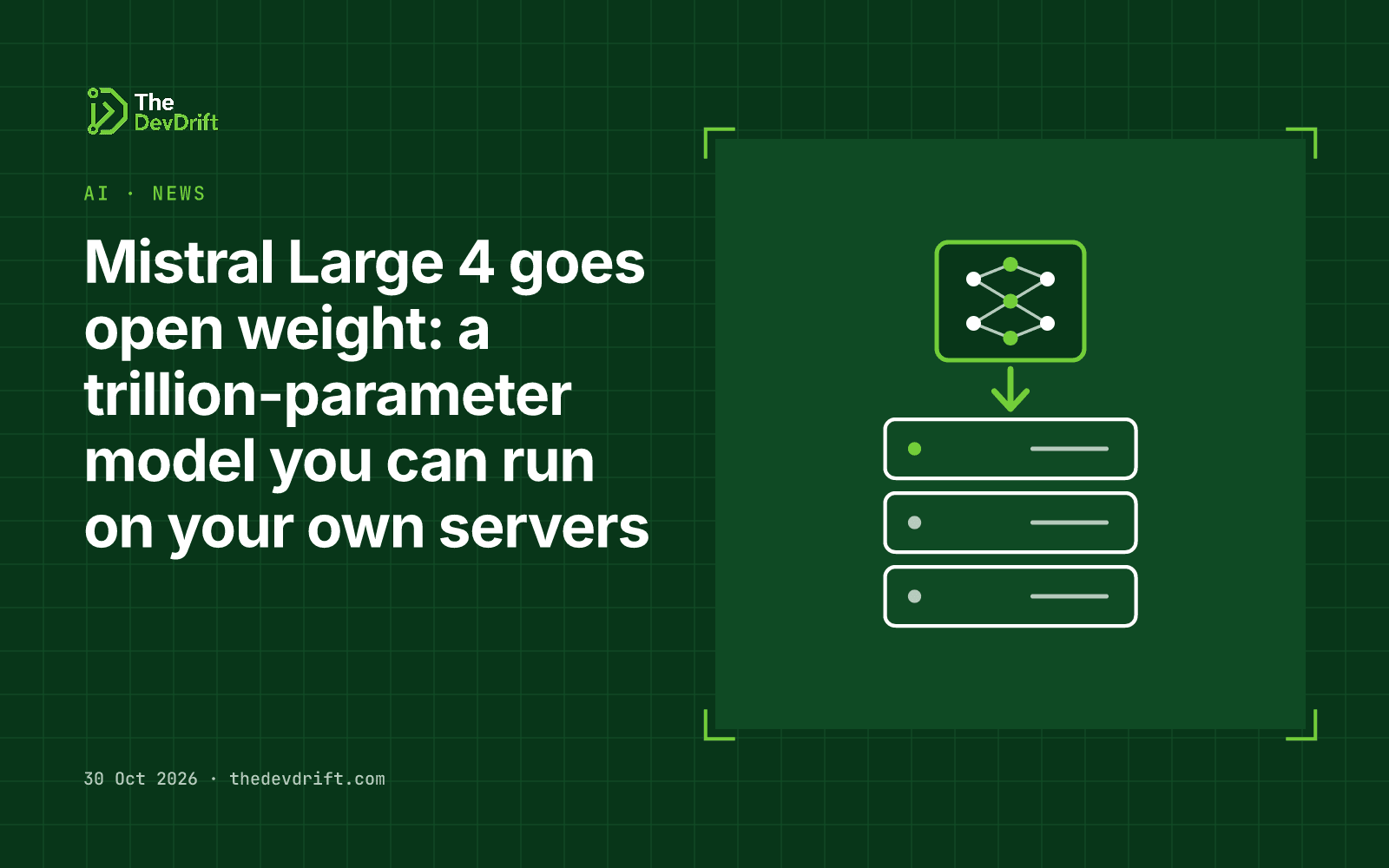
On 29 October 2026, Mistral released the weights of Mistral Large 4, the model it nicknames "Le Chonk", which had been in public preview earlier in the month. Anyone can now download the model from Hugging Face and run it on their own infrastructure, or call it through Mistral's API. Mistral describes it as a 1-trillion-parameter model trained from scratch in Europe.
For businesses that cannot send data to a US-hosted API, or that want a model nobody can switch off for them, this is a large European model they can now run in-house.
What the model is
Mistral Large 4 is a mixture-of-experts (MoE) model, a design where only part of the network works on each request, which keeps running costs lower than the total size suggests. It accepts multimodal input, and Mistral says it is fluent in more than 160 languages. It mixes instruction-following and step-by-step reasoning, with three reasoning settings: Low, Medium and High (the default). After the preview, Mistral spent more time on reinforcement learning, a training stage that rewards the model for completing tasks well.
Mistral is pitching it mainly at two jobs:
- Agentic coding. Mistral reports 48% on Artificial Analysis' Coding Agent Index, roughly level with the Chinese open model GLM-5.3 while using 47% fewer tokens per task, and 41% on Terminal-Bench 4.0, up from 28% for the preview. These are the vendor's own figures.
- Cyber defence. Mistral says the model can find, reproduce and patch software vulnerabilities, and scores 51% on Artificial Analysis' Cyber Index. It reports a 96.6% average refusal rate on malicious cyber requests. A separate, more permissive security variant for penetration testing is limited to vetted design partners such as Orange Cyberdefense, under contract.
Mistral is also open about a risk: in its own testing it saw the model refuse attacks on live targets, but still sees "a potential for uplift to conduct real attacks", so it says it is adjusting the guardrails.
Speaking to TechCrunch, Mistral's VP of Science Pierre Stock argued that open weights mean access cannot be cut off and that companies can deploy the model on-premises.
What it costs
If you do not want to host it, the model is available through Mistral Studio and the Mistral API, OpenRouter, NVIDIA-hosted endpoints and Microsoft Foundry. Mistral lists API pricing of $0.70 per million input tokens, $0.07 per million cached input tokens and $2.10 per million output tokens. (A token is a chunk of text, roughly three-quarters of a word.)
Self-hosting is free of licence fees for most uses, but not free to run. A trillion-parameter model needs a multi-GPU server, not a laptop. Mistral points to vLLM and SGLang for serving it, and NVIDIA offers an optimised NIM container and TensorRT-LLM support.
The licence catch
The weights ship under the Mistral Ecosystem Open-Weight licence, which Mistral calls a modified MIT licence. You can use, modify, fine-tune and sell products built on it. The exception: if your business offers the model itself as a hosted service (model-as-a-service), you need a separate commercial licence from Mistral. If you are a software vendor planning to resell access to the model, read the full licence text before you build on it.
Who should care
- EU businesses and regulated industries that need data to stay on their own servers or with a European provider.
- Security teams who want an AI model for code review and vulnerability triage that can run inside their own network.
- Engineering leads comparing coding-agent costs. Compare the API price above with what you pay today, and check quality on your own code before switching.
Limits and caveats
- The benchmark scores are Mistral's own. Independent results will follow over the coming weeks.
- Mistral's announcement does not state the context window (how much text it can read at once) or hardware requirements. Check the model card before planning a deployment.
- The specialised security variant is not generally available.
What to do this week
- If you already pay for a closed model for coding or document work, run a small side-by-side test with Mistral Large 4 through the API. It costs little to try.
- If data residency is a blocker for AI adoption in your company, put self-hosting this model on the shortlist and get a GPU cost estimate.
- If you sell software, have someone read the licence's model-as-a-service clause before anyone builds on it.
The DevDrift helps teams test and integrate models like this one into real workflows, with approvals and audit trails.