Google announces Gemini 4 Carbon: a security-focused model most businesses can't use yet
Google announced Gemini 4 Carbon on 28 October, its strongest model so far, aimed at finding and fixing software flaws and at long-running engineering work. Access starts with selected cyber defenders only.
- Author
 Umair Mateen
- Published
- Reading time
- 4 min
- Category
- AI
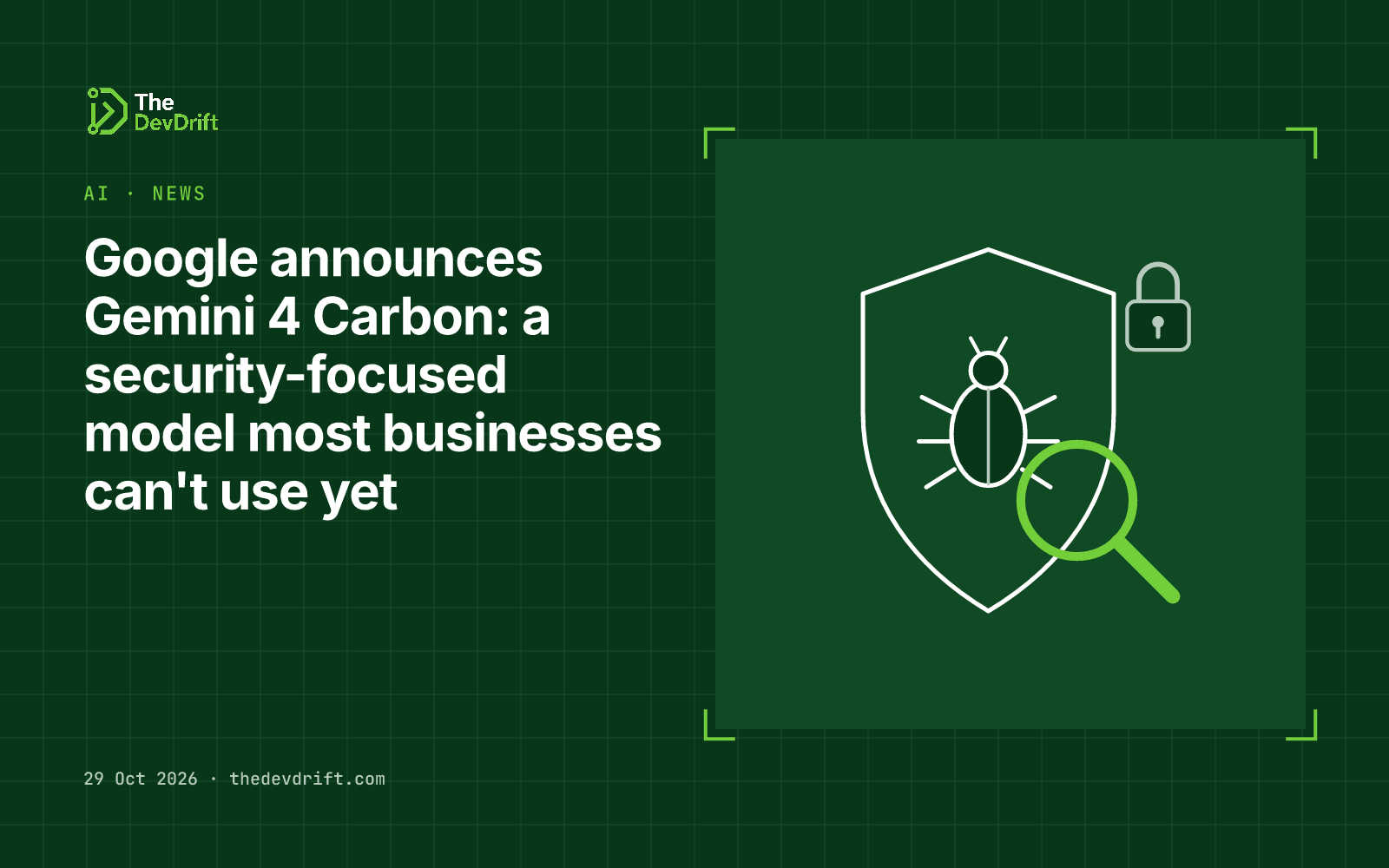
On 28 October 2026 Google announced Gemini 4 Carbon, which it calls its strongest model to date. It arrives two weeks after Gemini 4 Argon and is built with a clear focus: cybersecurity and long, multi-step engineering work. The catch for most companies is access. For now Carbon is only available to a subset of cyber defenders.
What Google says Carbon does
Google describes Carbon as designed for sustained "agentic" work, meaning the model plans and carries out a chain of steps on its own rather than answering a single question. The examples in the announcement are multi-day engineering tasks, tracking down the root cause of a bug in a large codebase and writing the patch, and other multi-step jobs.
On security, Google positions Carbon across the whole cycle: finding vulnerabilities, confirming they are real, and fixing them. The announcement cites the Chrome team's results on patch generation and the cloud security company Wiz on web penetration testing.
Google also reports changes in behaviour compared with Argon, based on its own internal testing:
- About half as many unsupported claims, and more clarifying questions when a request is ambiguous.
- Fewer cases of doing more than asked (down 26%) or less than asked (down 29%).
- High-severity misalignment alerts in its live internal coding environments down by almost 80%.
The benchmark numbers, and how to read them
Google lists several results: 88.2% on SEC-bench Pro (finding vulnerabilities), 54.8% on ExploitGym (exploiting them), 71.0% on CWE-bench (patching them), and first place with a score of 59 on the Artificial Analysis Intelligence Index, a combined score across many tests. It also reports 0.0% attack success on a test of indirect prompt injection, where hidden instructions inside a web page or document try to hijack the model.
Two caveats matter. First, these are Google's own published figures. Second, Google notes that the external cybersecurity benchmarks were run without guardrails, so the version a customer eventually gets, with safety filters switched on, may behave differently. Treat the numbers as a direction of travel, not a promise of what you will see in your own code.
Who can use it, and when
Access started this week with selected cyber defenders. Google says it will widen access gradually to more trusted partners through its Fairwind Program, and bring Carbon to developers, businesses and consumers as soon as possible once it has gathered feedback and tightened safeguards. In Google's words: "We're taking a deliberate approach to rollout." No dates are given for the Gemini API, the Gemini app or Google Cloud.
Google also says it is taking part in the US government's voluntary pre-release model testing, and has published a safety and security report for the Gemini 4 family.
What it will cost
Google has published pricing ahead of wider availability. The introductory price is $2 per million input tokens and $10 per million output tokens, the same as Argon, with cached input at 95% off. After the introductory period, which has no stated end date, the price doubles to $4 and $20. A token is roughly three-quarters of an English word, so a million tokens is a long book's worth of text.
Who should care
- Security teams and managed security providers. This is the group Google is serving first. If you defend critical systems, it is worth asking whether you qualify for early access.
- Software teams with a large, older codebase. Finding and patching flaws at scale is the use case Google is pushing hardest. You can't use Carbon yet, but it signals where AI-assisted code maintenance is heading.
- Anyone budgeting for AI. The planned doubling after the introductory period is worth building into estimates now if you expect to adopt Gemini models.
Limits and open questions
- No general availability date, and no model card or developer documentation for Carbon yet.
- The length of the introductory pricing period is not stated.
- Benchmark results are self-reported and were run without guardrails.
What to do this week
- Don't change plans around Carbon yet. If you build on Gemini today, Argon is the model you can actually use.
- Review how you handle vulnerability fixes. Note where the slow steps are (triage, reproducing, patching, review). Those are the steps models like this aim at, and knowing them makes any future pilot faster to judge.
- If you run security for critical infrastructure, read the Fairwind Program page and ask your Google contact about eligibility.
- Keep humans in the loop. Even a strong model's patch should go through code review and testing before it ships.