OpenAI releases GPT-6.1 Terra: a cheaper mid-tier model for screen, document and form work
OpenAI's GPT-6.1 Terra arrived on 26 October at $1 per million input tokens, with computer use, a 1M-token context window and rollout in ChatGPT Work and Codex. Here is what it does and where it fits.
- Author
 Umair Mateen
- Published
- Reading time
- 4 min
- Category
- AI
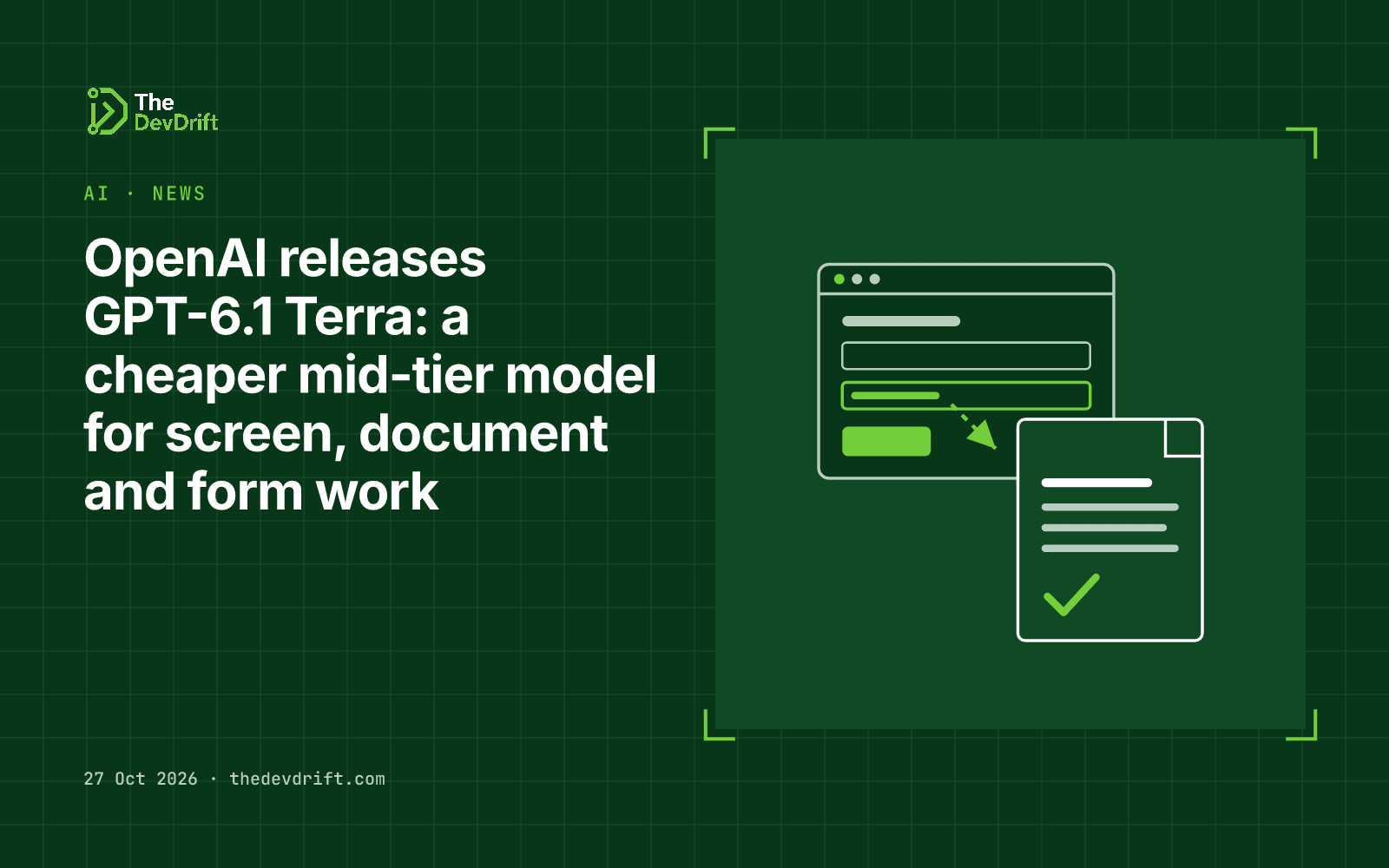
On 26 October 2026 OpenAI released GPT-6.1 Terra, a fast mid-tier model aimed at visual reasoning, computer use and everyday writing. According to OpenAI's model release notes, it is available in the API as gpt-6.1-terra and is rolling out in ChatGPT Work and Codex.
What it actually does
OpenAI's model page describes Terra as a fast, efficient model for three kinds of work: reading images (for example matching product photos to catalogue entries or interpreting technical drawings), operating software screens, and drafting or revising text.
"Computer use" means the model looks at screenshots of an application and returns actions such as clicks and keystrokes, so it can work through software that has no API. In OpenAI's API this is offered as a tool in the Responses API, alongside web search, file search, code interpreter, a hosted shell, MCP connections (a standard way to plug in your own tools and data) and skills. Tool calling requires the Responses API.
Key specifications from the model page:
- Context window: 1,050,000 tokens, with up to 128,000 output tokens.
- Inputs: text and images. Output is text only; audio and video are not supported.
- Reasoning effort: adjustable from
nonethroughlow,medium(the default),high,xhighandmax. - Knowledge cutoff: 1 June 2026.
- Not supported: fine-tuning.
What it costs
Standard API pricing per million tokens is $1.00 for input, $0.05 for cached input and $5.00 for output. A few details matter for budgeting:
- Prompts over 272,000 input tokens are billed at double the input and cache rates and 1.5 times the output rate, for the whole request. A long document dump can quietly raise your bill.
- Batch and Flex processing are 50% cheaper than Standard; fast mode costs twice Standard.
- Writing to the prompt cache is charged separately ($1.25 per million tokens for 30-minute retention, $2.50 for 12-hour retention), and regional processing adds 10% where offered.
The API has no free tier for this model. OpenAI's release notes also state that API usage is billed separately from ChatGPT subscriptions.
Who should care
Terra is pitched at high-volume, routine work rather than the hardest reasoning problems. If your team has people copying data between systems, keying invoices into an accounting tool, checking forms against source documents, or matching images to a product catalogue, this is the class of task OpenAI built it for. Software teams already using OpenAI models for agents may also want to test whether Terra can replace a more expensive model on the simpler steps of a workflow.
For business owners, the practical point is cost per task. A cheaper model that can read screens and documents makes it more realistic to automate back-office steps that previously needed a person, or a costly top-tier model, in the loop.
Limits and caveats
- Not in ordinary ChatGPT chat. The release notes say: "In ChatGPT, Terra is available in Work and Codex, not Chat."
- Data residency. The release notes say Terra does not support UAE inference residency. Teams with strict residency rules elsewhere should check region support before planning around it.
- Benchmarks are the vendor's. OpenAI has published performance comparisons with its own launch. Treat these as claims until independent testing appears, and test on your own tasks.
- Computer use carries real risk. A model that can click buttons can also click the wrong one. Screens can contain instructions planted by others (prompt injection), so agents that act on live systems need tight permissions and human checks.
What to do this week
- Pick one repetitive screen or form task and write down how a person does it today, including how long it takes and how often mistakes happen.
- Run a small trial of Terra on that task in read-only mode, or with every action queued for human approval, before giving it write access to anything.
- Compare cost per finished task, not price per token, against the model or process you use now. Watch the 272,000-token threshold.
- Check your contracts and residency needs if the task touches customer or financial data.
The DevDrift helps teams put AI automation like this into their workflows with approval steps and audit trails.