OpenAI brings GPT-Live-1.1 to the API and adds a cheaper standby rate for voice agents
OpenAI's GPT-Live-1.1 voice model is now in the API with better accents and number handling, plus a standby mode that bills idle voice sessions at $0.02 a minute instead of $0.05.
- Author
 Umair Mateen
- Published
- Reading time
- 3 min
- Category
- AI
Ideas in this post
Tap one for a 5-second answer. Underlined words in the article work the same way.
0 of 4 understood
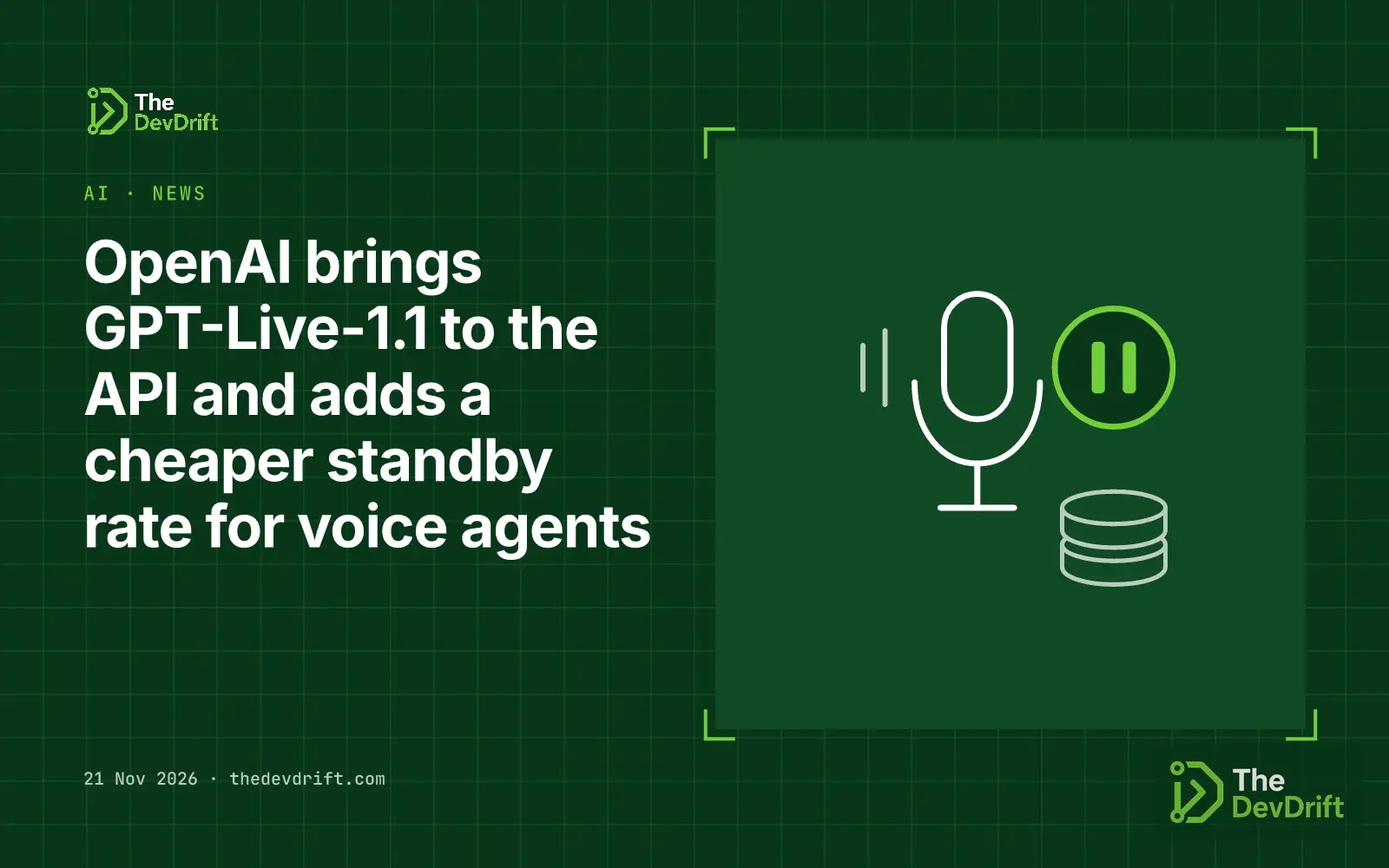
OpenAI has made GPT-Live-1.1 available in its API, announced on 20 November 2026 (the API changelog lists it on 19 November). Alongside it comes a standby mode that charges less while a voice call sits silent.
GPT-Live is OpenAI's : it can listen and talk at the same time, and hands harder reasoning and to a separate model. The first version, GPT-Live-1, became generally available in the on 10 September 2026, according to the changelog.
What's new in 1.1
OpenAI says the update improves:
Quick check · Everyday ↔ real
The restaurant and the API, side by side
Switch between the two and see how each part lines up.
- You, the customer
- The menu
- Your order to the waiter
- The kitchen
- Your dish, or "sold out"
You order from the menu and the waiter brings back your dish, without you ever seeing the kitchen.
| Everyday | Real |
|---|---|
| You, the customer | The client (your app) |
| The menu | The documentation |
| Your order to the waiter | The request |
| The kitchen | The server |
| Your dish, or "sold out" | The response, or an error |
From the explainer What is an API? Explained with a waiter in a restaurant
- pronunciation and accent consistency across languages,
- understanding of spoken letters and numbers, which matters for order numbers, postcodes and spelling out names,
- transcription in multilingual conversations,
- following instructions and finishing tasks reliably.
This is not a brand-new, untested model. In OpenAI's words, "GPT-Live-1.1 has powered voice in ChatGPT Plus and Pro since October 15." Developers call it with the model ID gpt-live-1.1 and can swap it into an existing Live session setup.
Standby mode and pricing
The more practical change for anyone paying the bill is standby. You set an idle timeout between 5 and 60 seconds. When nobody speaks for that long, the model pauses while the call stays connected, and it picks up again when someone talks. Standby works for calls over WebRTC (the browser and app calling technology) and is available for both GPT-Live-1 and 1.1.
- Active voice: $0.05 per minute.
- Standby: $0.02 per minute while paused.
- Backend model and tools: billed separately at their normal rates, according to the announcement and the GPT-Live model page.
Voice agents often spend a lot of time waiting: a customer looking for a booking reference, someone on hold, a long pause while a form loads. Those minutes now cost less than half the active rate. How much you save depends entirely on how much silence your calls contain, so check your own call logs rather than assuming a figure.
Limits and caveats
- Standby applies to WebRTC sessions. The announcement doesn't say it covers phone calls made over SIP.
- The per-minute voice price is only part of the cost. Every time the voice model hands work to a backend model or tool, that is charged on top.
- The GPT-Live-1 model page lists concurrent session limits by account tier (for example 50 on the Build tier) and no free-tier access. Check the limits for your account before planning a launch.
- Better accent and number handling is OpenAI's own claim. Test with your real callers' languages and the kinds of codes and numbers they read out.
What to do this week
- Already on GPT-Live-1? Run a side-by-side test with
gpt-live-1.1on recorded or scripted calls, focusing on names, numbers and non-English speakers. - Turn on standby for browser or app voice sessions and start with a short timeout, then watch whether the pause and resume feels natural to callers.
- Re-cost your voice agent using real call data: active minutes, silent minutes and backend model usage per call.
- Considering voice for support or bookings? The lower idle price makes long, patient calls cheaper to run, but plan a clear handover to a person for anything the agent shouldn't decide alone.
The DevDrift helps teams build AI voice and chat agents with approvals, handover to staff and audit trails.
Sources
You’ve read the news. Now understand it.
- Learn · 5 min · Everyday ↔ realWhat is an API? Explained with a waiter in a restaurantAn API is a set of rules that lets one program ask another for data or a task and get an answer back. Explained with a waiter carrying orders between you and the kitchen.Start in 5 seconds →
- Learn · 5 min · Side by sideWhat is a voice agent? Explained with a receptionist who never puts you on holdA voice agent is an AI you talk to out loud that listens, checks your systems and answers in a spoken voice. Explained with a front-desk receptionist who answers every call straight away.Start in 5 seconds →
- Learn · 5 min · Put it in orderWhat is tool use in AI? Explained with a calculator in an examTool use, or function calling, lets an AI model ask your software to run a tool, like a lookup or a calculator, and use the result. Explained with a student allowed a calculator in an exam.Start in 5 seconds →
- Learn · 5 min · Everyday ↔ realFrontend vs backend, explained with a restaurantThe frontend is the part of an app people see and use; the backend is the hidden part that stores data and applies the rules. Here's the difference, explained with a restaurant's dining room and kitchen.Start in 5 seconds →