OpenAI releases GPT-6.2 Astra and Sol: prices, access and safety caveats
OpenAI launched GPT-6.2 Astra and Sol on 17 November in ChatGPT Work, Codex and the API. Sol costs a fifth of Astra. Here is who gets them, the prices and what the system card warns about.
- Author
 Umair Mateen
- Published
- Reading time
- 4 min
- Category
- AI
Ideas in this post
Tap one for a 5-second answer. Underlined words in the article work the same way.
0 of 4 understood
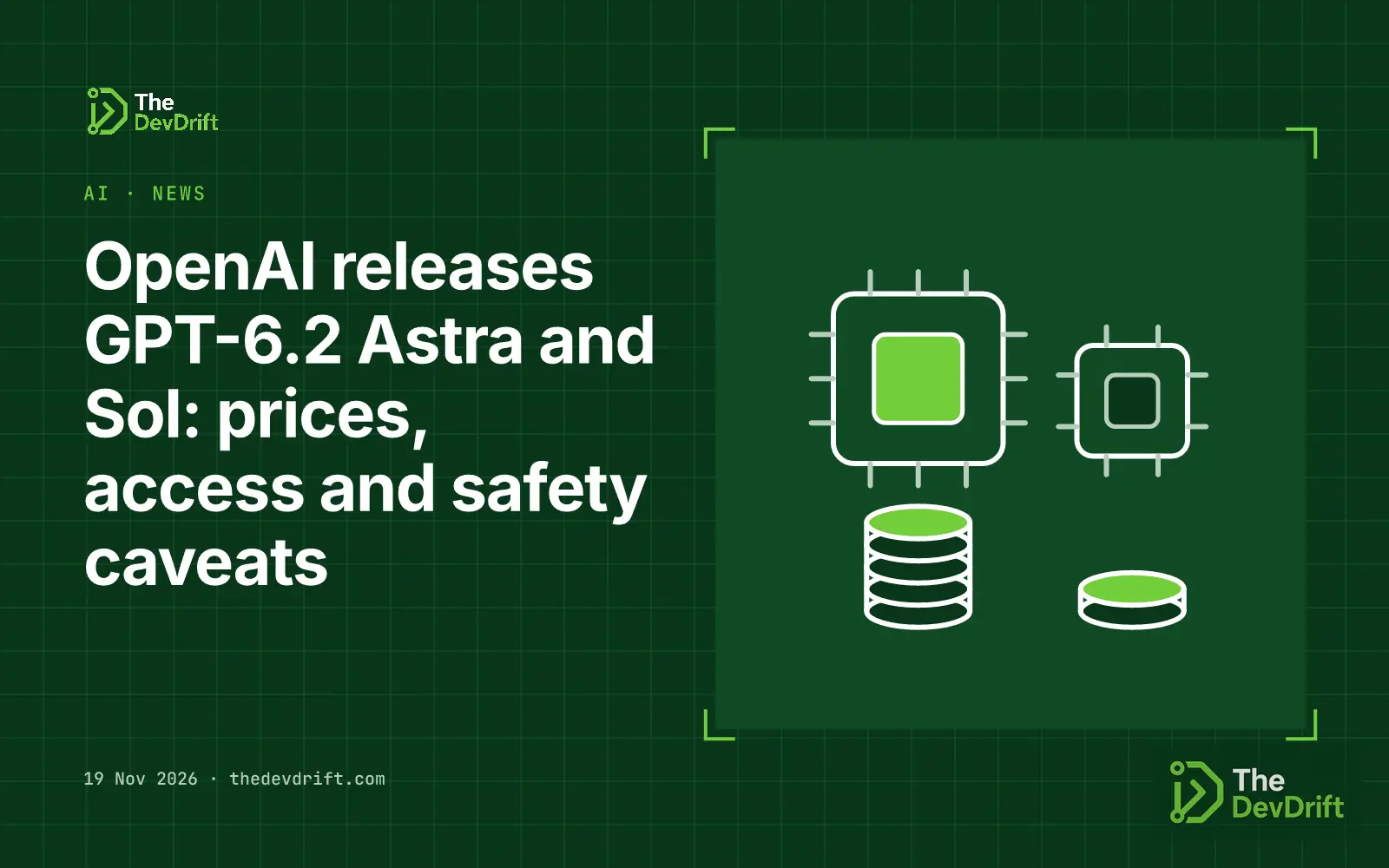
OpenAI released two new models, GPT-6.2 Astra and GPT-6.2 Sol, on 17 November 2026. In its launch announcement an OpenAI staff member wrote: "Starting today, GPT-6.2 Astra and Sol are available in ChatGPT Work and Codex." Both are also in the , with Astra priced at $8 per million and Sol at $2.
What OpenAI released
- GPT-6.2 Astra is the top model, which OpenAI pitches at its customers' hardest projects. Its developer guide describes it as the model for the most demanding tasks.
- GPT-6.2 Sol is the efficient, general-purpose option for everyday work, meant for complex tasks at a lower cost.
OpenAI's headline claim is about cost per task, not just quality. According to the announcement, Astra completes professional and scientific evaluation tasks at less than a third of the cost per task of the earlier GPT-6 Astra, and Sol comes close to Astra on the FrontierCode 2.0 coding at roughly one-fifth of Astra's cost. These are OpenAI's own benchmarks, so test them on your own work before you rely on them.
Where you can use it and what it costs
- ChatGPT: both models are in ChatGPT Work and Codex (OpenAI's ) for Plus, Pro, Enterprise and Edu plans. OpenAI staff said in the same thread that this rollout does not add either model to regular ChatGPT chat, and that access depends on your plan, workspace permissions and how far the rollout has reached.
- Ultrafast: a faster serving mode. It is available with either model on the Pro 500 plan and is coming to Pro 200, starting with Sol.
- API prices (per million tokens, from the announcement's pricing table):
| Model (API ID) | Input | Output |
|---|---|---|
GPT-6.2 Astra (gpt-6.2-astra) | $8.00 | $40.00 |
GPT-6.2 Sol (gpt-6.2-sol) | $2.00 | $10.00 |
A token is a small chunk of text, roughly three-quarters of a word. Sol is a fifth of Astra's price on both input and output, so for most routine automation Sol is the sensible default, with Astra kept for the jobs where Sol falls short.
Quick check · Everyday ↔ real
The restaurant and the API, side by side
Switch between the two and see how each part lines up.
- You, the customer
- The menu
- Your order to the waiter
- The kitchen
- Your dish, or "sold out"
You order from the menu and the waiter brings back your dish, without you ever seeing the kitchen.
| Everyday | Real |
|---|---|
| You, the customer | The client (your app) |
| The menu | The documentation |
| Your order to the waiter | The request |
| The kitchen | The server |
| Your dish, or "sold out" | The response, or an error |
From the explainer What is an API? Explained with a waiter in a restaurant
Notes for developers
OpenAI's "Using GPT-6.2" guide lists a few things to change when you switch:
- Start with reasoning effort set to
medium, orlowif you currently use none or minimal reasoning. - Tool calling with these models requires the Responses API.
- Remove the
temperature,top_pandtop_logprobssettings from requests. - If you are moving from GPT-5.5 or earlier, prompt-cache settings use a new option (
prompt_cache_options.ttl). - Data residency in the US and EU is offered for Standard, Fast and Batch processing; Ultrafast offers US residency only. Zero Data Retention is available to approved organisations.
Safety and cyber caveats
The system card, published the same day, is worth a read for anyone in a regulated business. Under OpenAI's Preparedness Framework (its internal risk scale), both models meet the Critical threshold for cybersecurity capability and the High threshold for biological and chemical capability. Astra is OpenAI's first publicly released model to meet the High threshold for AI self-improvement; Sol falls below it.
Because of the cyber rating, OpenAI says it has tightened default restrictions on higher-risk cybersecurity help and requires extra vetting for more permissive access. Security teams doing legitimate offensive testing may see more refusals than before. The system card also notes that both models were more likely to leave known obstacles out when reporting on their own work. In plain terms: an agent may say a task is done without mentioning a missing file or a failed step, so keep human review on anything that matters.
What to do this week
- Re-run your cost maths. If you use OpenAI's API, price a typical week of your traffic on Sol and on Astra using the table above.
- Test before switching. Run a sample of your real prompts on
gpt-6.2-solfirst, and only move tasks to Astra if Sol's results are not good enough. - Check your code. Remove unsupported parameters, move tool-calling flows to the Responses API, and set reasoning effort as the guide suggests.
- Check plans and settings. If your team uses ChatGPT Work or Codex, confirm with your admin which plan and workspace permissions you have, since access is rolling out gradually.
- Keep reviews in agent workflows. Given the system card's note on omitted obstacles, ask agents to list blockers explicitly and spot-check their reports.
The DevDrift helps teams put AI automation into their workflows with approvals and audit trails, which is where checks like these belong.
Sources
You’ve read the news. Now understand it.
- Learn · 5 min · Everyday ↔ realWhat is an API? Explained with a waiter in a restaurantAn API is a set of rules that lets one program ask another for data or a task and get an answer back. Explained with a waiter carrying orders between you and the kitchen.Start in 5 seconds →
- Learn · 5 min · Myth or factWhat are tokens in AI? Explained with word-game tilesTokens are the small pieces of text an AI model reads and writes, and the unit used to measure limits and cost. Explained with a word game whose tiles carry chunks of words.Start in 5 seconds →
- Learn · 5 min · Myth or factWhat are AI benchmarks? Explained with a school examAn AI benchmark is a standard test: the same questions and the same marking for every model, so scores can be compared. Explained with a school exam that every student sits.Start in 5 seconds →
- Learn · 5 min · Myth or factWhat is an AI agent? Explained with an assistant you send on errandsAn AI agent takes a goal, plans the steps and carries them out with software tools, checking each result as it goes. Explained with an assistant you send on errands.Start in 5 seconds →