Meta says AI agents now handle over 60% of rolling out improvements across its ad models
Meta explains how agents adapt, test and roll out proven improvements across its ads models, with people approving what ships. The results it reports and the lessons for smaller teams.
- Author
 Umair Mateen
- Published
- Reading time
- 4 min
- Category
- AI
Ideas in this post
Tap one for a 5-second answer. Underlined words in the article work the same way.
0 of 3 understood
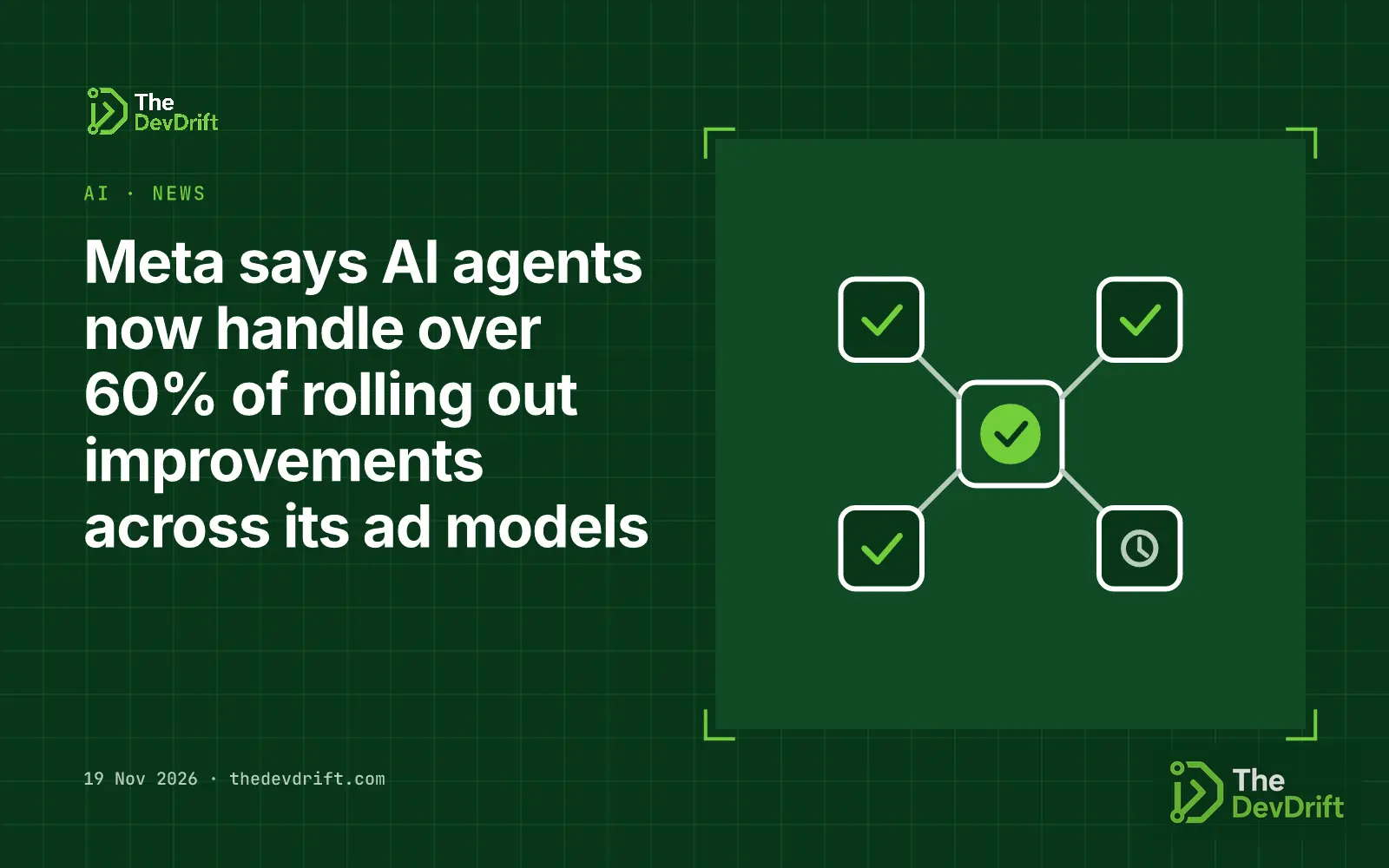
Meta published a detailed account on 18 November 2026 of how now do most of the work of rolling out proven improvements across its many ads ranking models. Meta says agents have driven this work since March 2026 and estimates they now handle more than 60% of it, with people still approving what ships.
The problem Meta was solving
Meta runs many machine learning models that decide which ads to show. When engineers prove that a new technique improves one model, it rarely works on the next model as-is, because each has its own design, data and limits. Adapting it by hand takes expert time and a per attempt. Meta says that today it takes over a year for a proven technique to reach every model it could help, and its goal is to cut that to three months.
What the agents do
The system builds on Meta's earlier Ranking Engineer Agent, which finds and proves new techniques. The new work covers what happens next, in three stages:
Quick check · Myth or fact
AI agents: myth or fact?
Decide for yourself first, then tap each statement to check it.
0 of 3 checked
From the explainer What is an AI agent? Explained with an assistant you send on errands
- Discovery: agents keep a list of proven techniques, estimate which other models each could help, and rank the candidates by expected impact. Engineers review that ranking and decide.
- Generalisation: agents re-write the technique for other models, test it on scaled-down versions first, diagnose failures and try again. For Meta's highest-revenue models, experts still do the work by hand, with agents learning from their changes.
- Adoption: agents launch and watch multi-day training runs, tune each model, fix routine failures such as infrastructure errors or broken data pipelines, and prepare a proposal. They also decide which jobs get computing capacity and stop low-value runs early.
A shared record of past training runs lets the agents start from settings that worked before instead of searching from scratch.
The checks before anything ships
Meta says agent-made changes face the same bar as an engineer's: better offline accuracy without higher training or serving cost, then a statistically significant win in a live A/B test. People set priorities, approve plans and make the final call. Meta also tracks how often humans have to step in on each experiment.
The results Meta reports
Meta frames these as early results, and most are estimates:
- "we estimate AI agents handle over 60% of all technique propagation."
- Each engineer can handle about three times as many model adaptations as before.
- A median four-fold cut in training compute, measured on select technique-and-model pairs.
- A projected $45 million or more in compute savings by the end of the year. This is a forecast, not a realised figure.
Meta is open about what isn't solved. Its most valuable models still get hand-tuned by experts because that gives the best results, and sharing a fixed compute budget across hundreds of running jobs is still an open problem it is working on.
Why it matters outside Meta
Few companies have hundreds of ranking models, but many have the same pattern on a smaller scale: a fix or improvement proven in one place that never reaches the other ten places it would help. Meta's write-up is a useful template because the agents don't decide what ships. They do the repetitive adaptation, testing and babysitting of long jobs, while people review rankings, approve plans and sign off on results measured against fixed rules.
Two details are worth copying. First, Meta standardised its models into shared templates before adding agents, which is what made automation practical; it credits that earlier step with cutting per-model engineering time by 92% over two years. Second, it measures the agents on human interventions per task, not just on output.
What to do this week
- List one process where a proven change has to be repeated across many similar systems: reports, integrations, service configurations or prompts.
- Before automating it, check how standardised those systems are. If every one is different, templates come first.
- Write down the pass/fail rules a change must meet before it ships, so an agent can be held to the same bar as a person.
- Decide where a human approves, and track how often people have to step in.
The DevDrift helps teams add AI agents to repeat work with clear approval steps and .
Sources
You’ve read the news. Now understand it.
- Learn · 5 min · Myth or factWhat is an AI agent? Explained with an assistant you send on errandsAn AI agent takes a goal, plans the steps and carries them out with software tools, checking each result as it goes. Explained with an assistant you send on errands.Start in 5 seconds →
- Learn · 5 min · Everyday ↔ realTraining vs inference, explained with studying for an exam and sitting itTraining is when an AI model learns from huge amounts of data; inference is when the finished model answers your question. Explained with a student who studies for months, then sits the exam.Start in 5 seconds →
- Learn · 5 min · Myth or factWhat is an audit trail? Explained with a visitor logbookAn audit trail is a time-ordered record of who did what in a system, when and with what result. Explained with the visitor logbook at an office reception desk.Start in 5 seconds →