GitHub Universe 2026: Copilot Fusion picks the model for you, and Agentic Workflows reach general availability
At GitHub Universe on 28 October, GitHub made Copilot Fusion generally available, so Copilot chooses and combines models per task, and opened Agentic Workflows to all plans. What changes for teams and their bills.
- Author
 Umair Mateen
- Published
- Reading time
- 4 min
- Category
- Engineering
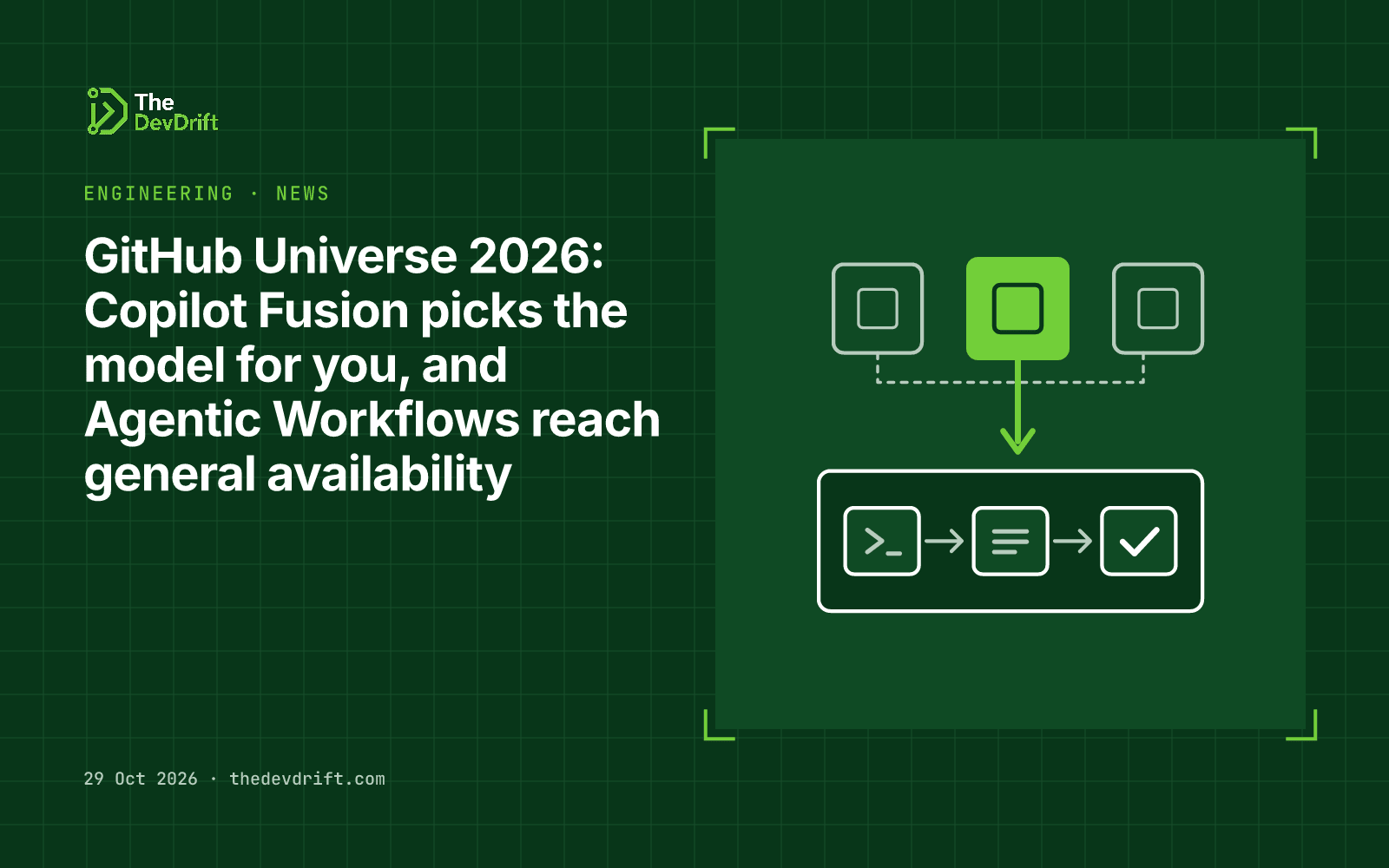
At its Universe conference on 28 October 2026, GitHub made two AI features generally available: Copilot Fusion, which decides which AI models to use for each request, and GitHub Agentic Workflows, which runs coding agents inside GitHub Actions. Both matter to team leads because they change how AI coding costs are spent and how much routine repository work can be automated.
Copilot Fusion: stop choosing models by hand
Until now, Copilot users picked a model from a list. With Fusion, you pick "Fusion" and Copilot decides which model or combination of models handles each prompt. It brings together GitHub's earlier HydraFusion research preview and Copilot's automatic model selection.
You choose an effort level:
- Standard for everyday coding.
- High for harder tasks that need deeper reasoning.
- Max for the most demanding work.
Behind that, Fusion uses one of three patterns. Single: one model does the job. Cascade: a cheaper model drafts, a quality check accepts it or passes it to a stronger model. Critique: one model drafts, a second reviews, the first revises.
GitHub reports that on the Artificial Analysis Coding Agent Index, Fusion Max scored 60, about two points below Claude Code with Opus 5.5 Max, at roughly half the average API cost per task and about 40% less time. These are GitHub's own figures and the changelog does not publish the full method, so test on your own work before relying on them.
What it costs, and what admins control
Fusion is billed per model it calls, at that model's normal rate. Paid plans get a 30% discount on model costs for a limited time; GitHub gives no end date. Fusion is available on all Copilot plans in VS Code, the GitHub Copilot app, Copilot CLI and JetBrains IDEs, after updating the client.
For governance, the key line is that "Copilot Fusion only uses the models that are enabled" in your enterprise and organisation policies. Admins can see which models Fusion draws on, disable a model just for Fusion, and make Fusion the default. Anyone who used auto mode or HydraFusion in preview is moved to the matching Fusion level automatically.
Agentic Workflows: AI jobs that run in Actions
GitHub Agentic Workflows, an open source project from GitHub Next, is now generally available on GitHub Free, Team and Enterprise. You describe a task in a plain-language Markdown file, such as triaging new issues, analysing a failed CI run, updating docs or writing tests, and it compiles into a normal GitHub Actions workflow. That means it runs on your existing runners and under your existing policies.
The security defaults are worth knowing:
- Agents get read-only permissions by default.
- They run in a sandboxed container behind a firewall, with an option for micro-VM isolation.
- Proposed changes go through a validation step ("safe outputs") and a threat-detection job before anything is applied.
The default engine is GitHub Copilot CLI, which needs a Copilot licence, but you can bring another coding agent and choose a model provider per workflow. A command, gh aw forecast, estimates AI credit spend before you commit.
Other Universe news
GitHub's Universe overview also covered Copilot projects (parallel agent sessions across several repositories, available now in the Copilot app), a deeper "Max" tier for Copilot code review, and a move for GitHub Enterprise customers to use all Copilot features under usage-based AI credits without a separate subscription. GitHub did not publish credit rates in that post, and existing Copilot Business and Enterprise customers can keep their current plans.
Limits and caveats
- Performance and cost claims are GitHub's own and lack full methodology.
- The 30% Fusion discount is temporary with no stated end date.
- AI credit pricing for the new Enterprise bundle was not published in the announcement.
What to do this week
- Check your model policies first. Because Fusion only uses enabled models, review which models your organisation allows before rolling it out.
- Run a two-week comparison. Let a few developers use Fusion at Standard or High and compare cost and quality against your current default.
- Pick one boring task for Agentic Workflows, such as labelling new issues or summarising failed CI runs. Keep the read-only default and run
gh aw forecastbefore enabling it. - Ask your GitHub contact for AI credit rates before considering the Enterprise bundle.
The DevDrift helps teams put AI automation into their workflows with approvals and audit trails.