Claude API adds a usage and cost analytics API, and fast mode on Opus 4.8 is being retired
Anthropic has launched a beta API that breaks Claude spend down by model, workspace, key and user, and set 30 November as the end of fast mode on Claude Opus 4.8. What changes for teams paying Claude bills.
- Author
 Umair Mateen
- Published
- Reading time
- 5 min
- Category
- AI
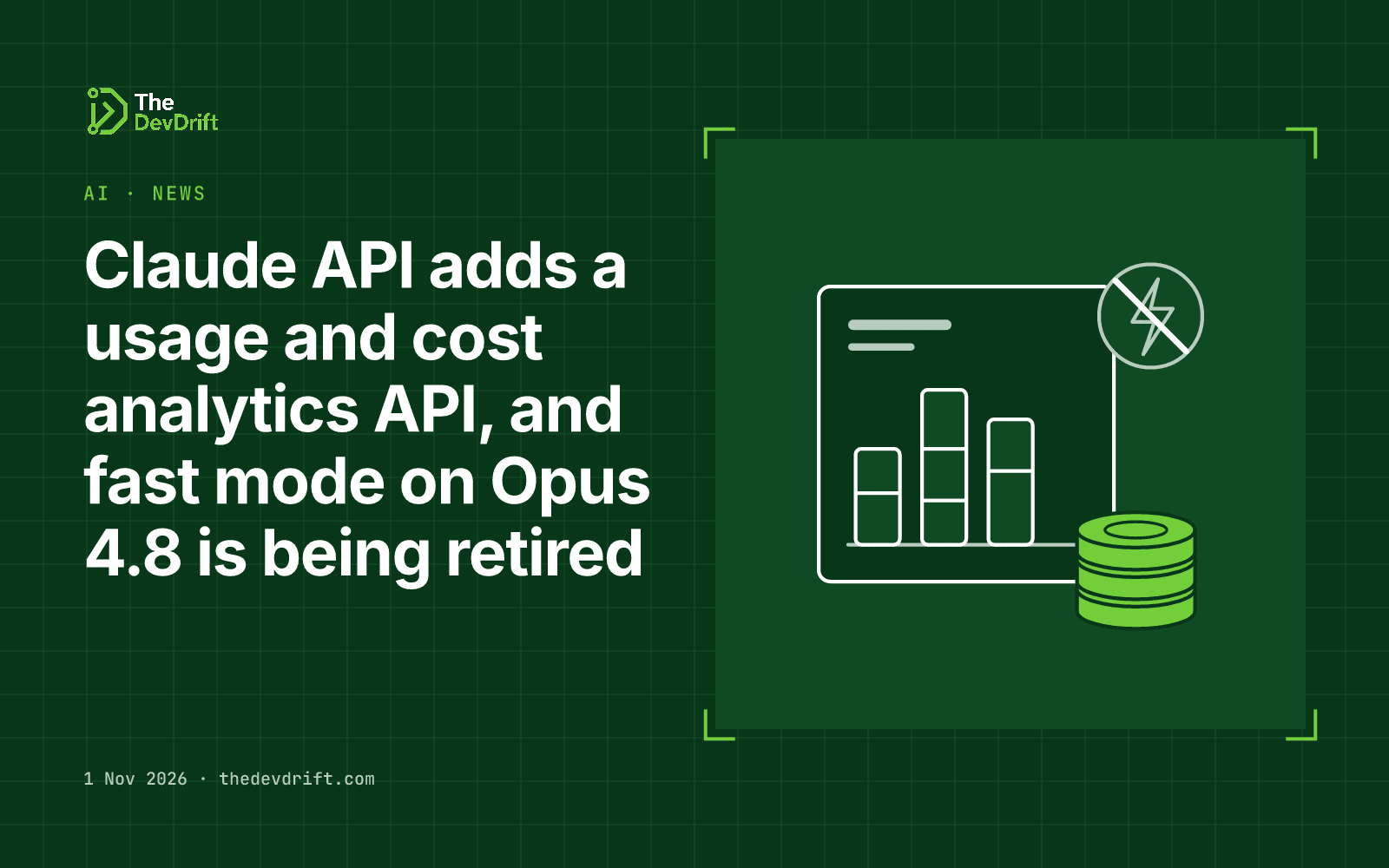
Anthropic made two changes to the Claude API this week that matter to anyone who pays for or runs Claude in production. On 29 October it launched a Usage and Cost Analytics API in beta, and on 30 October it deprecated fast mode for Claude Opus 4.8, with removal scheduled for 30 November 2026.
The new analytics API
The Usage and Cost Analytics API reports historical token usage and cost for an organisation. It has two endpoints: one returns token and request counts, the other returns cost in US dollars. You can break the numbers down by model, workspace, API key, and the person or service account behind each request (Anthropic calls this the "actor").
In practice, that means a finance lead or engineering manager can answer questions like "which team's workspace is driving this month's bill?" or "how much of our spend is on our most expensive model?" from data, without exporting spreadsheets from the console.
Useful details from the documentation:
- Who can use it: Claude Console organisations with an Admin API key or admin credential, and Claude Enterprise organisations with a key that has analytics read access. Individual accounts can't use it. Claude Platform on AWS and Claude models on Google Cloud managed by Anthropic are also supported, with their own authentication.
- Grouping: up to five dimensions at once, with filters that can be combined.
- Time buckets: per minute, per hour or per day (UTC), or a single total for the whole range.
- Range: data from 1 January 2026 onward, within the last 365 days, with up to 31 days per request (24 hours when using per-minute buckets).
- Cost fields: each row shows the amount after discounts but before credits, and the amount at list price, so you can see what discounts are worth.
Caveats
- It is a beta. Requests need a beta header, and details may change.
- It is not real time. Anthropic says data typically refreshes within 4 hours and can take up to 24. That is slower than the legacy Console usage report, which the docs say refreshed in about 5 minutes. Use it for reporting and chargeback, not for live spend alarms.
- Month-end numbers move. Values can change until about 7 days after a month ends, so wait before treating a month as final.
- Priority Tier commitment fees aren't included. Priority Tier requests show zero token cost in this data.
- The old APIs still work. The previous Usage and Cost API and the Claude Enterprise usage and cost report endpoints are now labelled legacy but remain supported, and Anthropic has published migration notes.
Fast mode on Opus 4.8 ends 30 November
Fast mode is an option that runs a model at higher output speed. According to the release notes, after 30 November 2026 any request to claude-opus-4-8 with fast mode turned on will return an error. Anthropic's advice is to move to Claude Opus 5.5 if you want to keep using fast mode, and it links a migration guide.
This only affects you if your code sets fast mode on Opus 4.8. Ordinary Opus 4.8 requests are not part of this notice. Still, a request that errors in production is a support ticket waiting to happen, so it is worth a search of your codebase now rather than in the last week of November.
Also this week: bigger requests
On 28 October Anthropic raised the maximum request size for the Messages API and the Token Counting API on its own first-party API from 32 MB to 128 MB. That helps teams sending large documents or many images in one request.
Who should care
- Finance and operations leads who need to allocate AI spend to teams, clients or products.
- Engineering managers running several apps or agents on one Claude organisation who want to see which ones cost what.
- Developers with Opus 4.8 fast mode anywhere in their code.
What to do this week
- Search your code and config for Opus 4.8 requests with fast mode enabled. If you find any, test them on Opus 5.5 using Anthropic's migration guide, and schedule the switch well before 30 November.
- Create a dedicated, expiring admin credential for whatever service will pull cost data. The docs recommend a separate key stored in a secrets manager and rotated regularly.
- Pull last month's costs grouped by workspace and model. Even one report usually shows where spend is concentrated and whether a cheaper model could handle some of the work.
- If you already use the legacy reports, plan the move to the new endpoints, but note the slower refresh before replacing any near-real-time dashboard.
The DevDrift helps teams build AI automations with cost tracking, approvals and audit trails built in, if you want help putting this data to use.