Anthropic lets companies run Claude Managed Agents on their own servers
Anthropic has launched self-hosted Claude Managed Agents: you run the agent service, its storage and its sandboxes on your own cloud or data centre, and choose where model calls go. Access is through Anthropic's account team.
- Author
 Umair Mateen
- Published
- Reading time
- 4 min
- Category
- AI
Ideas in this post
Tap one for a 5-second answer. Underlined words in the article work the same way.
0 of 2 understood
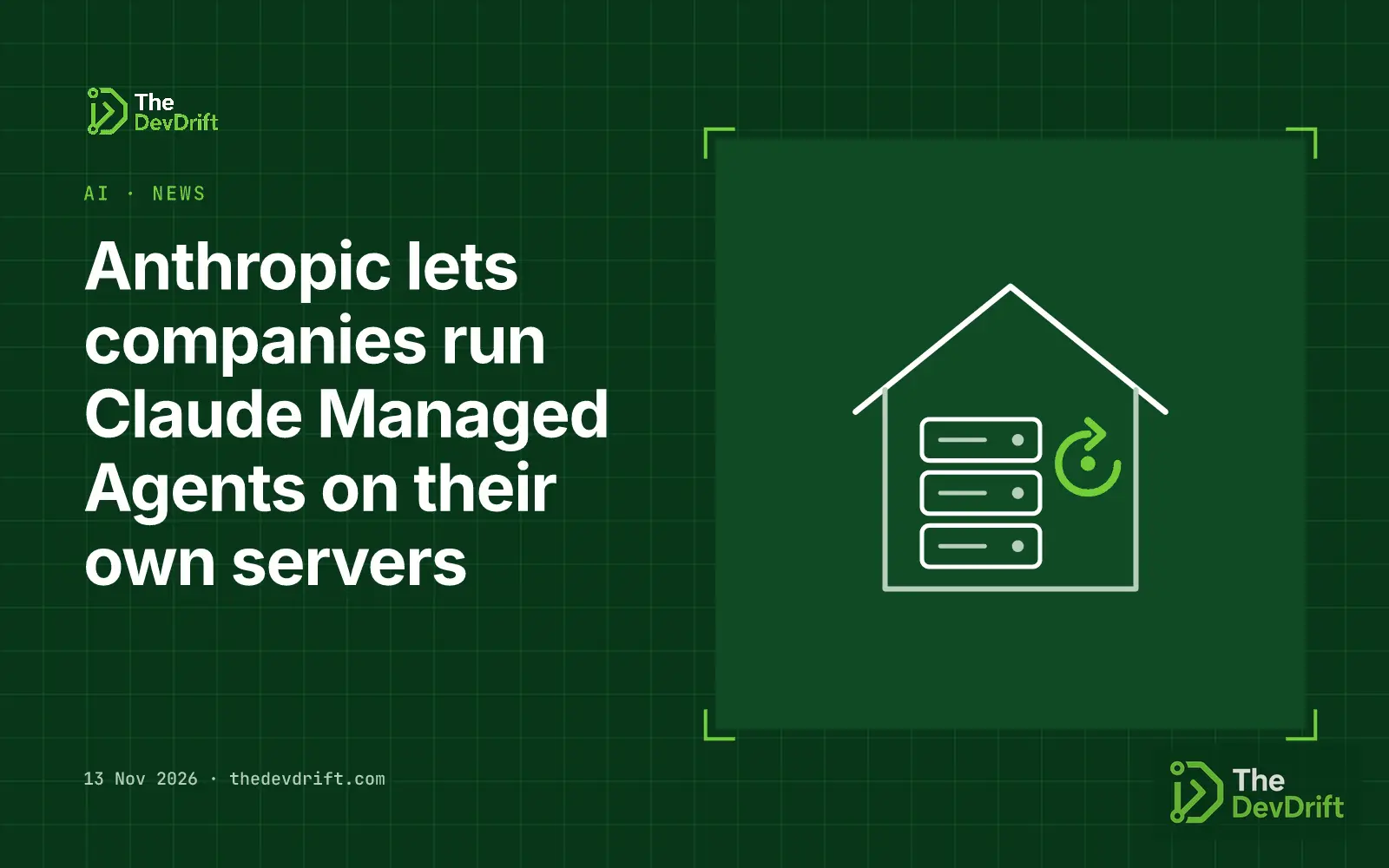
Anthropic has launched self-hosted Claude Managed Agents, listed in its platform release notes on 12 November 2026. Companies can now run the whole Managed Agents service on their own infrastructure, in their own cloud account or data centre, instead of only running the agents' sandboxes themselves.
What it actually does
Claude Managed Agents is Anthropic's hosted service for running : it keeps track of agents, their sessions and their history, runs the loop that decides the next step, and executes tools in a sandbox (an isolated computer where the agent's commands run). Until now, the service itself lived at Anthropic. Anthropic's self-hosted documentation now describes three set-ups:
| Option | Sandboxes | Agent service and storage | Model |
|---|---|---|---|
| Cloud sandboxes (default) | Anthropic | Anthropic | Anthropic |
| Self-hosted sandboxes | You | Anthropic | Anthropic |
| Self-hosted Managed Agents (new) | You | You | Anthropic or a provider you choose |
In the new option, a server you run handles the , runs the agent loop and stores agents, sessions and history in your own PostgreSQL database. Separate worker programs run the agent's shell and file tools inside your containers. It offers the same API as the hosted service, so existing code and Anthropic's command-line tool point at your server instead. Anthropic names Docker Compose and a Helm chart for Kubernetes as deployment options.
Quick check · Myth or fact
AI agents: myth or fact?
Decide for yourself first, then tap each statement to check it.
0 of 3 checked
From the explainer What is an AI agent? Explained with an assistant you send on errands
Model calls can go to the Claude API (the default), Amazon Bedrock, Claude Models on Google Cloud, Microsoft Foundry or your own model gateway. Sign-in for staff can go through your own identity provider, and credentials can live in your own secret manager.
Who should care
Companies that like what AI agents can do but cannot let agent history leave their own systems: banks, insurers, healthcare, the public sector, or anyone whose contracts require data to stay in a given cloud or region. It also suits teams that already buy Claude through AWS, Google Cloud or Azure and want everything billed and governed there.
Limits and caveats
- Not fully private: each model call still sends the conversation so far, including tool inputs and results, to whichever model provider you choose. Self-hosting controls where the history is stored, not where the model runs.
- Access: you request it through your Anthropic account team. The docs give no pricing or licence terms.
- Fewer features: Anthropic's list of differences says self-hosted servers have no webhooks, no scheduled runs, no Files API, no prebuilt Word, PDF, PowerPoint or Excel skills, and only a simpler multi-agent mode. Web search and fetch tools are off by default, and some depend on the model provider.
- You run it: nothing is copied from the hosted service, so agents, skills and stored credentials must be recreated. Anthropic warns that the agent's shell has the worker's permissions and network access; isolation comes only from the container you put it in, and each trust level needs its own deployment.
What to do this week
- If data residency has kept agents out of a project, write down exactly which data must stay in-house. If only tool execution matters, Anthropic points to the simpler self-hosted sandboxes option.
- Check the feature differences against what your agents use today, especially webhooks, file handling and scheduled runs.
- Ask your security team who will patch and monitor the server, database and worker containers, and plan one deployment per trust level.
- If it fits, contact your Anthropic account team for access and start with one low-risk internal agent.
The DevDrift helps teams put AI agents into their workflows with approvals and audit trails, including where data has to stay on their own systems.
Sources
You’ve read the news. Now understand it.
- Learn · 5 min · Myth or factWhat is an AI agent? Explained with an assistant you send on errandsAn AI agent takes a goal, plans the steps and carries them out with software tools, checking each result as it goes. Explained with an assistant you send on errands.Start in 5 seconds →
- Learn · 5 min · Everyday ↔ realWhat is an API? Explained with a waiter in a restaurantAn API is a set of rules that lets one program ask another for data or a task and get an answer back. Explained with a waiter carrying orders between you and the kitchen.Start in 5 seconds →