Claude API adds message threads for faster long conversations, and watermarks three older models
Anthropic's new message threads beta keeps a conversation on the server so long agent loops send only new messages, with no price change. Plus: Anthropic's text watermark now covers Mythos 5, Opus 4.7 and Sonnet 4.6.
- Author
 Umair Mateen
- Published
- Reading time
- 4 min
- Category
- AI
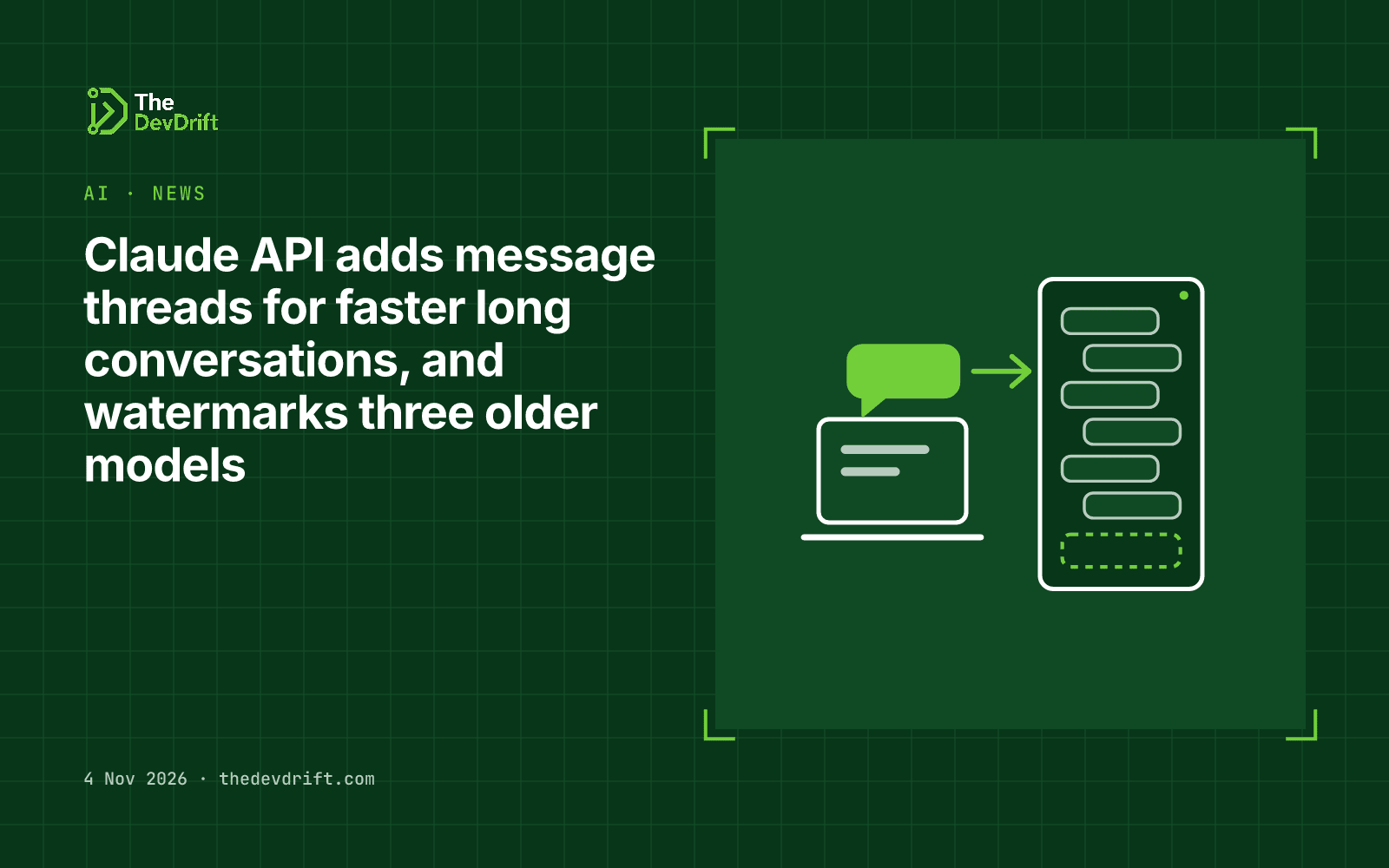
Anthropic has added message threads to the Claude Messages API, in beta since 2 November 2026. According to the Claude platform release notes, the API can now keep a conversation on the server for a short time, so each new request in a long conversation or agent loop only sends what is new. A day later, on 3 November, Anthropic also extended its text watermark to three older Claude models.
What message threads do
Normally, every call to a chat model resends the whole conversation: the system prompt, the tool definitions and every earlier message. In a long-running agent that can mean re-uploading a very large request on every turn, and the API has to validate and tokenise all of it again before the model starts answering.
With a thread, as described in the message threads documentation:
- The first request sends the full conversation, system prompt and tools, plus a flag asking the API to create a thread.
- Later requests send only the new messages and the ID of the previous response. The API rebuilds the conversation itself before calling the model.
- The response is the usual Messages API response, so the rest of your code doesn't change.
The payoff is speed. Anthropic says requests get smaller and the time to first token (how long before the reply starts appearing) stays lower and steadier as a conversation grows. The docs say threads help most in long agent loops.
The docs are also clear on cost: "Threads do not change pricing or rate limits." Prompt caching still works as before, but you still have to ask for it; a thread does not cache anything for you.
Where it works
Threads are in beta on the Claude API, Claude Platform on AWS, Claude models on Google Cloud (Anthropic managed) and Claude in Microsoft Foundry. The supported list covers current models such as Claude Opus 5.5, Sonnet 5.5 and Haiku 5.5, plus several older ones back to Claude Sonnet 4.5. The official SDKs include a thread helper that builds the requests and handles recovery.
Limits and caveats
- Threads are short-lived and best-effort. A thread expires 5 minutes after its last request and is deleted no more than an hour after its last use. If it has gone, the next request fails and you resend the full conversation to start a new one. Your app must keep its own copy of every message.
- Not zero data retention (ZDR) eligible. The docs say thread contents are held in memory, encrypted, never written to durable storage, and deleted within an hour of last use. If your contract relies on ZDR, check with your legal or security lead before switching it on.
- Some features don't mix. Threads don't work with Message Batches, token counting, compaction, most context editing, organisations with HIPAA readiness enabled, or organisations using inference hooks.
- Fixed settings. The system prompt and tools are set once per thread. To change them, or to edit an earlier message, you start a new thread.
- No management API. There is no way to list, read or delete a thread.
Also new: the watermark reaches older models
On 3 November, the release notes say text generated by Claude Mythos 5, Claude Opus 4.7 and Claude Sonnet 4.6 now carries Anthropic's text watermark. Anthropic's text watermark page says the mark doesn't change the meaning, quality or readability of output, adds no tokens or hidden characters, and needs no changes to your requests.
One practical catch: on Sonnet 4.6, output from requests that set temperature, top_p or top_k to non-default values might not carry the mark. If you depend on the watermark (for example, to show AI-generated content is labelled), leave those three settings unset, including any defaults your framework adds.
What to do this week
- Find your long conversations. If you run support bots or agents with long histories, ask your developers whether time to first token is a complaint. Those are the best candidates for a thread trial.
- Check data-retention commitments before enabling threads, because they are not ZDR eligible.
- Test with the SDK helper rather than hand-building requests, and keep your own copy of the conversation so expiry is harmless.
- If you rely on watermarking, check whether your Sonnet 4.6 calls set sampling parameters, and remove them where you can.
The DevDrift helps teams build Claude-based agents with sensible logging, approvals and retention settings, if you want a second pair of eyes on a rollout.