Xen patches two VM-escape flaws found with Claude: what hosting teams should do
Xen advisory XSA-523 fixes two flaws that let a malicious virtual machine read and write other machines' memory, including the control domain. There is no workaround, so patching is the only fix.
- Author
 Umair Mateen
- Published
- Reading time
- 3 min
- Category
- DevOps
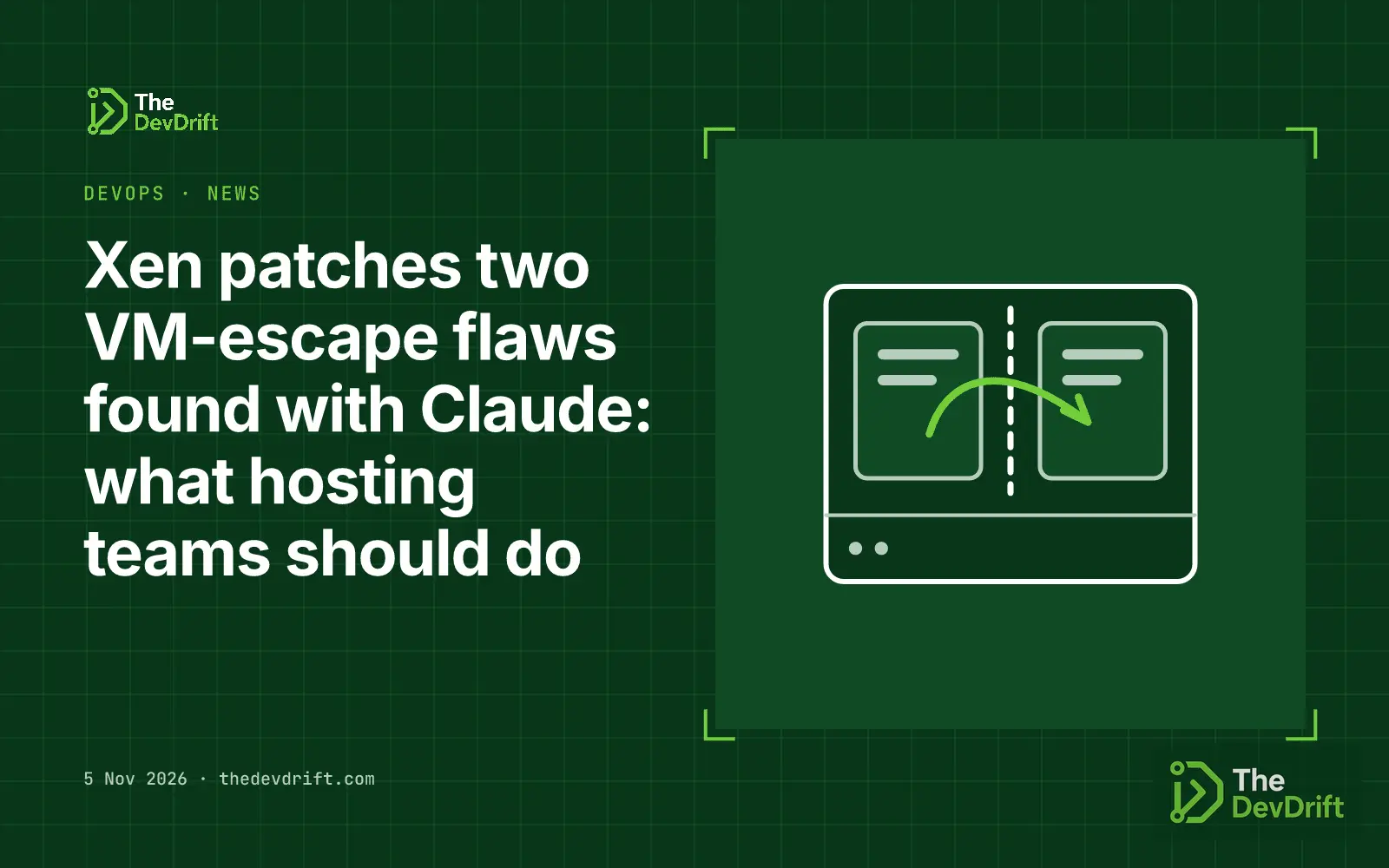
The Xen Project published security advisory XSA-523 on 3 November 2026. It fixes two flaws, CVE-2026-102703 and CVE-2026-102704, in how Xen handles “grant copy” operations. A malicious virtual machine could use them to read and write memory that belongs to other virtual machines on the same host, including Dom0, the privileged domain that manages the whole machine.
The advisory credits Anthropic with finding the issue using Claude. Stephan Lipp of Ada Logics then validated it, and the CodeAnt AI Security Research Team reported it independently.
What the flaw does
Xen is a hypervisor: the layer of software that lets one physical server run many separate virtual machines (VMs), each believing it has the hardware to itself. The whole point of a hypervisor is that one VM cannot see or touch another.
Xen lets VMs share memory pages with each other in a controlled way through a mechanism called grants, and “grant copy” is the operation that copies data between those shared pages. According to the advisory, a guest can abuse it to read and write arbitrary memory in other domains. In plain terms, this is a VM escape: code running inside one customer's VM could reach into a neighbour's VM, or into Dom0 and from there the rest of the host.
Who is affected
- Versions: every Xen release from 4.6 onwards. Xen 4.5 and earlier are not affected.
- Who should care most: anyone running Xen hosts where the VMs are not all equally trusted. That includes hosting companies, managed service providers, and internal platforms where different teams or customers share hardware.
- If you only rent cloud servers: host patching is your provider's job, not yours. Check your provider's security bulletins to see whether they use Xen and have applied the fix.
Limits and caveats
- No workaround. The advisory lists no known mitigation, so applying the patch is the only fix.
- Patches by version. Two patches each are published for xen-unstable and Xen 4.19.x, and a separate pair for Xen 4.18.x and 4.17.x. Older branches you run yourself may need a vendor or distribution update.
- Restarts. The advisory doesn't say whether a reboot is needed. Hypervisor patches usually mean restarting the host, so plan for moving or pausing VMs.
- Distribution timing. If you get Xen through a Linux distribution or a product built on Xen, wait for that vendor's package rather than patching source yourself.
Why the AI angle matters
This is one more serious bug, present in releases going back to Xen 4.6, found with help from an AI model and then confirmed by human researchers. A second team reported the same flaw independently. For defenders, the practical lesson is that the gap between a flaw being findable and being found is shrinking, so slow patch cycles carry more risk than they used to.
What to do this week
- Find your Xen hosts. Include appliances and products built on Xen, not just servers you installed by hand.
- Check versions. Anything at 4.6 or later is in scope.
- Get the fixed build from your vendor or distribution, or apply the patches from XSA-523 if you build Xen yourself.
- Schedule host restarts and move or pause VMs as needed, starting with hosts that run untrusted or customer workloads.
- Ask your cloud or hosting provider whether they are affected and when they patched, if you rely on them.