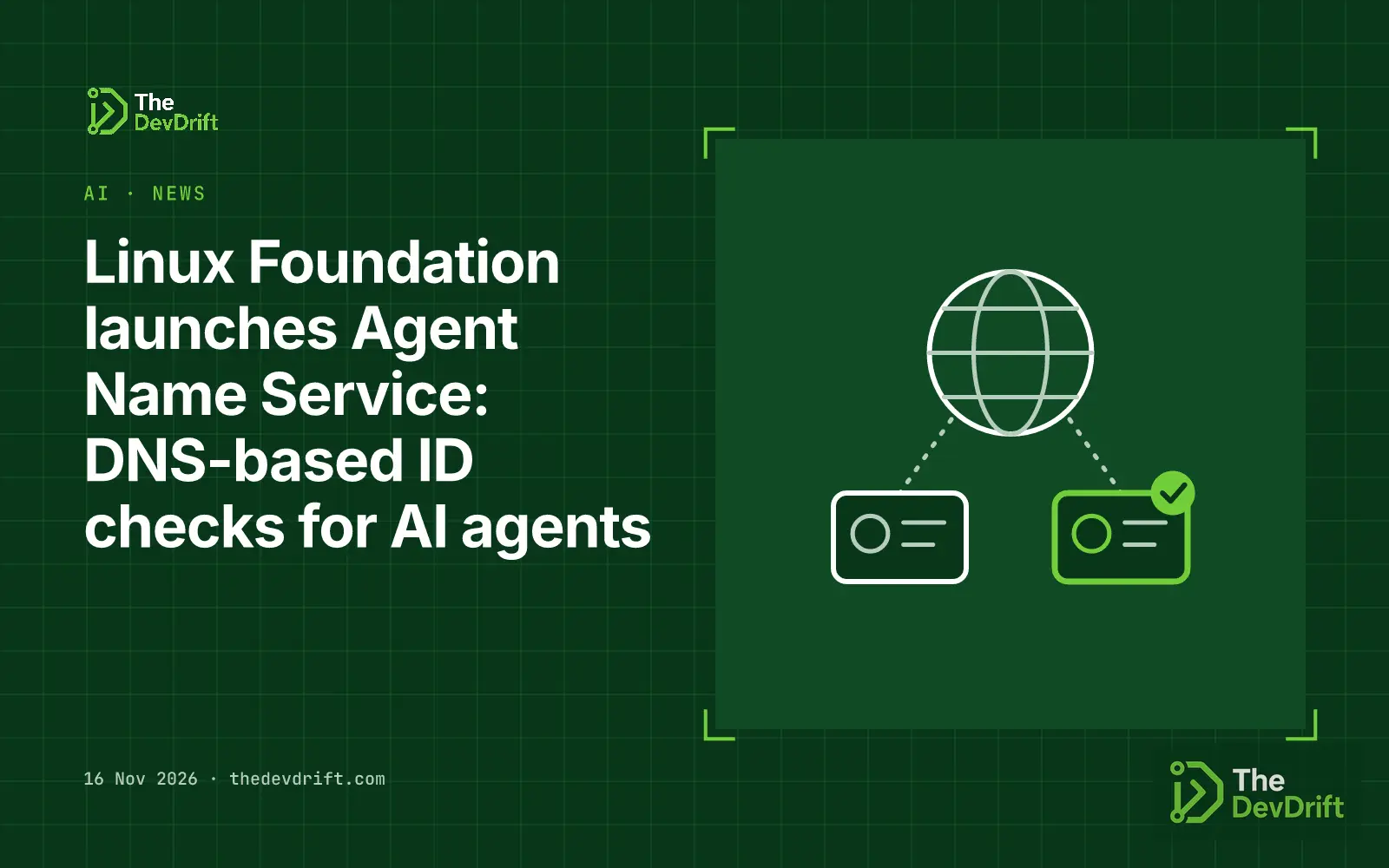
Linux Foundation launches Agent Name Service: DNS-based ID checks for AI agents
The Linux Foundation has launched Agent Name Service, an open standard that uses DNS and web certificates to give AI agents verifiable identities. Backed by Cisco, Cloudflare, GoDaddy, Salesforce and others.
- Author
 Umair Mateen
- Published
- Reading time
- 4 min
- Category
- AI
Ideas in this post
Tap one for a 5-second answer. Underlined words in the article work the same way.
0 of 4 understood
The Linux Foundation announced on 10 November 2026 that Agent Name Service (ANS) has launched as one of its projects. ANS is an open standard that uses the (DNS, the internet's address book) and the security certificates websites already use to give an identity others can check. We're covering it now because it hasn't appeared on this blog yet and is becoming a practical question for businesses.
The problem it tackles
As companies deploy AI agents that call other companies' agents and services, each side needs to know who it is talking to. Is this really your bank's booking agent, or something pretending to be it? Today there is no common way to answer that. ANS proposes one built on infrastructure that already exists, rather than a new central registry.
What ANS defines
According to the Linux Foundation release, the specification covers:
Quick check · Put it in order
You type a web address. What happens, in order?
Tap the steps in the order they happen.
From the explainer What is DNS? Explained with your phone's contacts list
- Naming. Agent names are tied to a domain the owner controls, the same way a website is.
- Registration and versioning. How an agent is registered and how new versions are recorded.
- Publishing through DNS. How an agent's identity is published so anyone can look it up.
- Public logs and monitoring. Auditing identity records in public logs and watching them for unauthorised changes.
- Agent-to-agent checks. How one agent verifies another's identity before trusting it.
The project is governed by a technical steering committee under the Linux Foundation, and the specification and code are published on GitHub, with more at ansinfo.ai.
Who is behind it
The release lists 11 organisations that have contributed to or adopted the standard since the Foundation's intent-to-launch announcement in June: Cisco, Cloudflare, DigiCert, DistributedApps.ai, GoDaddy, HOL, Infoblox, Radix, Salesforce, OWASP and Trustmodel.ai. Two early integrations are named: AGNTCY's Agent Directory Service, another Linux Foundation project, can verify ANS identities, and a tool called ANS Finder implements the Agentic Resource Discovery specification and, per the release, passes its registry conformance tests.
Who should care
- Companies publishing agents to customers or partners (support, booking, ordering, B2B integrations). A verifiable identity could make it easier for others to trust and connect to your agent.
- Security and IT leads who will be asked to allow outside agents to reach internal systems. A standard way to check who an agent belongs to is a building block for those policies.
- Domain and DNS owners. Because ANS sits on your domain, whoever manages your DNS will likely be involved if you adopt it.
Limits and caveats
- The release gives no version number, licence or maturity level for the specification. Treat it as an early open standard, not a finished one.
- The adoption claims come from the supporters themselves.
- Identity tells you who runs an agent, not whether it is safe or well behaved. You still need permissions, approvals and logging.
- Other agent identity and discovery efforts exist; it is too early to say which approach will become the norm.
What to do this week
- List the AI agents your business runs or plans to expose to outsiders, and note which domain each would belong to.
- Ask your DNS provider or registrar whether it plans to support ANS; GoDaddy, Cloudflare and Infoblox are among the listed supporters.
- If you buy agent platforms, ask vendors how their agents prove their identity to other systems, and whether ANS is on their roadmap.
- Have an engineer read the specification on GitHub before committing to any custom agent-identity scheme of your own.
The DevDrift helps teams connect AI agents to their systems with approvals and .
Sources
You’ve read the news. Now understand it.
- Learn · 5 min · Put it in orderWhat is DNS? Explained with your phone's contacts listDNS turns a website name people can remember into the number computers use to find it. Explained with tapping a name in your phone's contacts instead of typing the number.Start in 5 seconds →
- Learn · 5 min · Myth or factWhat is an AI agent? Explained with an assistant you send on errandsAn AI agent takes a goal, plans the steps and carries them out with software tools, checking each result as it goes. Explained with an assistant you send on errands.Start in 5 seconds →
- Learn · 5 min · Myth or factWhat is agent identity? Explained with a temp worker's ID badgeAgent identity gives each AI agent its own named account, separate from any person's login. Explained with a temp worker who gets their own ID badge instead of borrowing yours.Start in 5 seconds →
- Learn · 5 min · Myth or factWhat is an audit trail? Explained with a visitor logbookAn audit trail is a time-ordered record of who did what in a system, when and with what result. Explained with the visitor logbook at an office reception desk.Start in 5 seconds →