Google's Gemini Decisions API: cheap yes/no and multiple-choice answers with a confidence score
Google has launched the Gemini Decisions API, a new endpoint that answers fixed-choice questions about text, images, audio, video or PDFs, with a confidence score per answer, for $0.10 per million input tokens and nothing for output.
- Author
 Umair Mateen
- Published
- Reading time
- 4 min
- Category
- AI
Ideas in this post
Tap one for a 5-second answer. Underlined words in the article work the same way.
0 of 4 understood
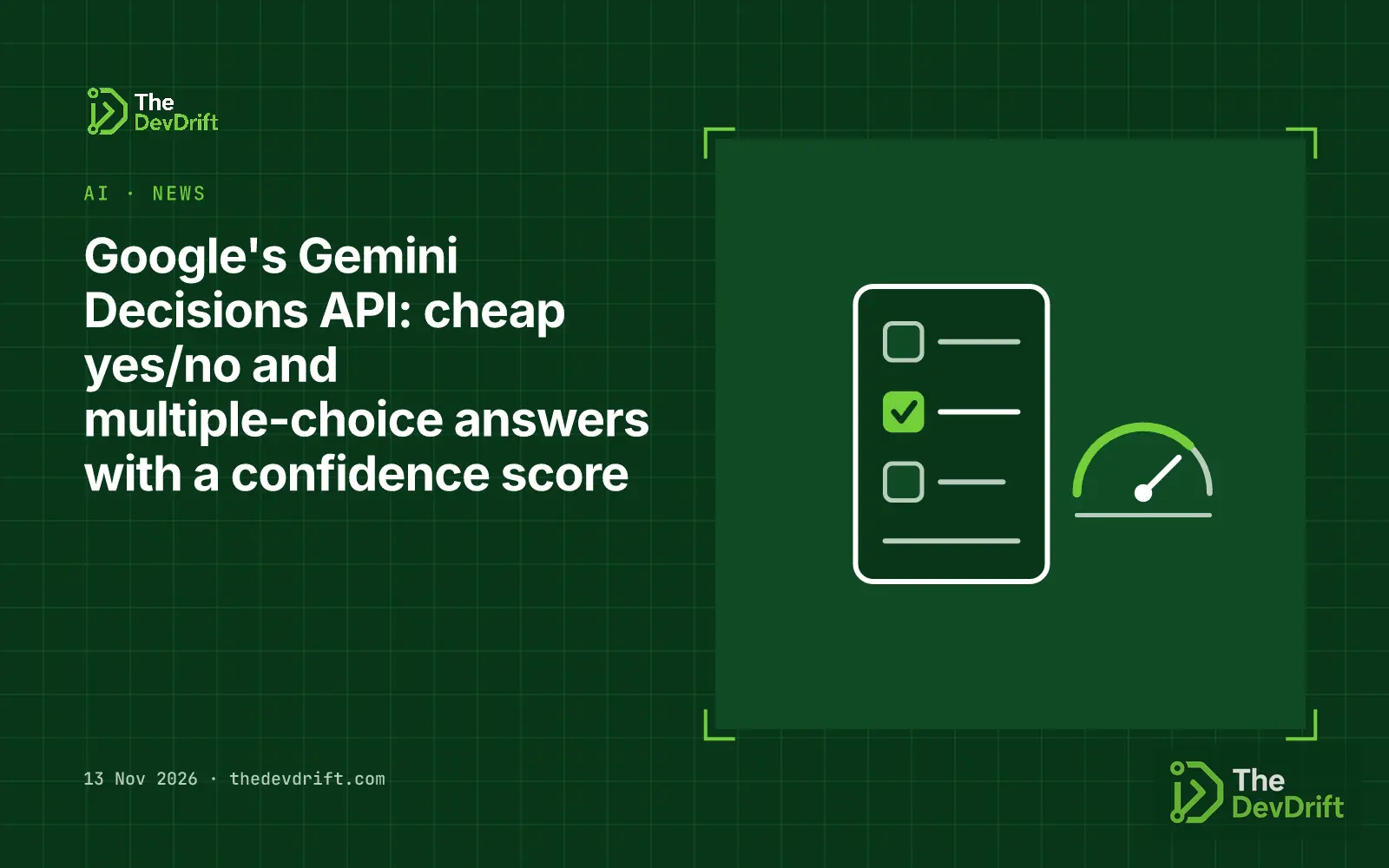
Google has launched the Gemini Decisions API, announced on 11 November 2026. It is a new endpoint built for one narrow job: answering questions where the possible answers are fixed in advance, such as yes or no, pick one of these options, or grade this on a scale. It runs on a new model, Gemini Decision 1 (gemini-decision-1).
What it actually does
Most AI calls ask a model to write an answer word by word. The Decisions skips that. You send one input and a list of questions, and it returns an answer to each, plus a confidence score between 0 and 1. Google says the model "scores your candidate options in a single forward pass" rather than generating text.
There are three question types, and you can mix them in one request:
Quick check · Everyday ↔ real
The restaurant and the API, side by side
Switch between the two and see how each part lines up.
- You, the customer
- The menu
- Your order to the waiter
- The kitchen
- Your dish, or "sold out"
You order from the menu and the waiter brings back your dish, without you ever seeing the kitchen.
| Everyday | Real |
|---|---|
| You, the customer | The client (your app) |
| The menu | The documentation |
| Your order to the waiter | The request |
| The kitchen | The server |
| Your dish, or "sold out" | The response, or an error |
From the explainer What is an API? Explained with a waiter in a restaurant
- Yes/No: the probability that a condition is true, for example "does this invoice include VAT?"
- Multiple choice: pick from 2 to 255 options and get a probability for each one.
- Ordered rubric: grade something on a scale starting at 0, returning a weighted score and the probability of each level.
The input can be text, images, audio, video or PDFs, or a mix, up to 256,000 tokens (a token is roughly three-quarters of a word). One request can carry up to 1,000 separate questions about the same input. Google's examples include a call recording plus account details, or a scanned claim form with photos of the damage.
What it costs and how fast it is
Google lists the price as $0.10 per million and $0 for output tokens. The shared input is billed once per request, however many questions you ask about it; each question only adds the tokens of its own wording. Google says there are no separate charges for thinking tokens, audio transcription or text extraction from scans. There is a no-cost tier in Google AI Studio for trying it out.
On speed, Google quotes 150 to 250 milliseconds end to end for inputs up to 16,000 tokens, staying nearly flat from 1 to 100 questions per request. Google also claims it is nearly five times cheaper than Gemini 3.5 Flash-Lite on its own suite. Those are Google's own measurements; test with your own data before relying on them.
Who should care
Any business that runs lots of small judgement calls through AI today. Typical cases:
- Routing support tickets or emails to the right team or the right model.
- Policy or compliance checks: does this listing, message or document break a rule?
- Checking whether an should be allowed to use a tool before it acts.
- Grading content or answers against a rubric.
The confidence score is the useful part for team leads. It lets your software send clear cases straight through and pass unclear ones to a person, which is how you keep a human in charge of the hard calls without reviewing everything. Google says it already uses the model inside its own products, including model routing in Gemini Notebook and a safety check for MCP tools in Google Search.
Limits and caveats
- Where: available now through the Gemini API and Google AI Studio. Support in Gemini in Google Cloud is listed as coming soon, with a sign-up form.
- Status: Google's post does not say whether this is a preview or general release, and the code sample uses the
v1betaAPI version. Treat it as early and check terms before putting regulated work through it. - Not for open answers: it chooses between options you define. It will not write a reply, a summary or an explanation.
- Benchmarks: Google says the model has the lowest calibration error on its test suite, but the post gives no figures in text, so you cannot compare them directly.
What to do this week
- List the AI calls in your products or automations that only ever return a label, a yes/no or a score. Those are candidates to move.
- Pick one, run a few hundred real examples through the Decisions API docs sample in AI Studio, and compare accuracy and cost with what you use now.
- Decide a confidence threshold below which a person reviews the case, and log the scores so you can adjust it.
- Keep any regulated or customer-facing decisions on a human review path until you have your own accuracy numbers.
The DevDrift helps teams put AI automation into their workflows with approvals and audit trails, which is where a confidence score like this is most useful.
Sources
You’ve read the news. Now understand it.
- Learn · 5 min · Everyday ↔ realWhat is an API? Explained with a waiter in a restaurantAn API is a set of rules that lets one program ask another for data or a task and get an answer back. Explained with a waiter carrying orders between you and the kitchen.Start in 5 seconds →
- Learn · 5 min · Myth or factWhat are tokens in AI? Explained with word-game tilesTokens are the small pieces of text an AI model reads and writes, and the unit used to measure limits and cost. Explained with a word game whose tiles carry chunks of words.Start in 5 seconds →
- Learn · 5 min · Myth or factWhat are AI benchmarks? Explained with a school examAn AI benchmark is a standard test: the same questions and the same marking for every model, so scores can be compared. Explained with a school exam that every student sits.Start in 5 seconds →
- Learn · 5 min · Myth or factWhat is an AI agent? Explained with an assistant you send on errandsAn AI agent takes a goal, plans the steps and carries them out with software tools, checking each result as it goes. Explained with an assistant you send on errands.Start in 5 seconds →