Drupal fixes a critical installer flaw that can lead to site takeover: update to 11.4.13
Drupal released security updates on 18 November for a critical flaw in its installer that can lead to site takeover or remote code execution. Here is who is affected and what to do.
- Author
 Umair Mateen
- Published
- Reading time
- 4 min
- Category
- DevOps
Ideas in this post
Tap one for a 5-second answer. Underlined words in the article work the same way.
0 of 1 understood
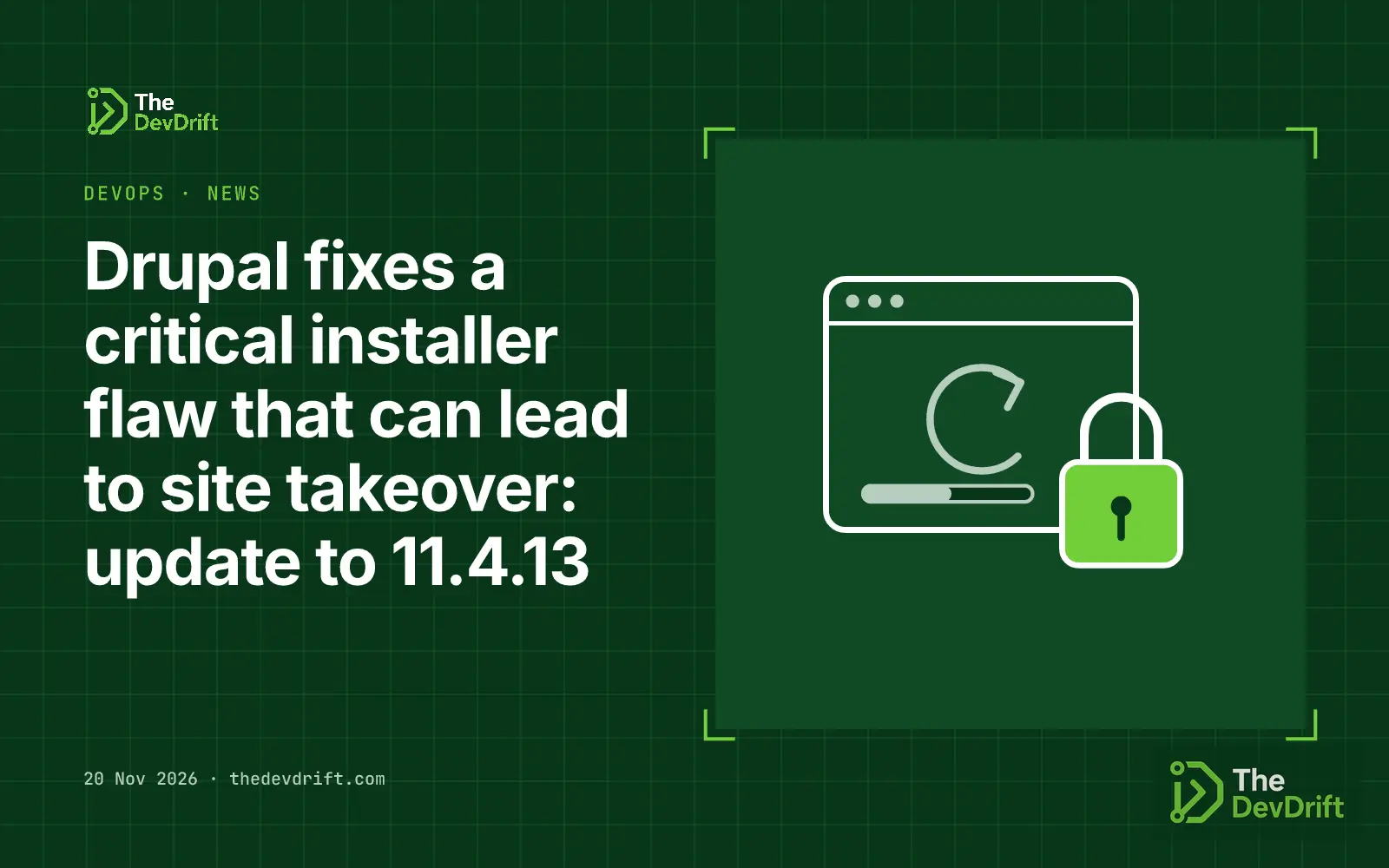
The Drupal Security Team published a critical security advisory, SA-CORE-2026-017, on 18 November 2026, alongside new core releases for every supported branch. The flaw is in Drupal's built-in installer, and the team says it can lead to a site takeover or remote code execution (an attacker running their own code on your server). If your company runs a Drupal website, it should be patched now.
What the flaw is
Every Drupal site ships with a setup script, install.php, used to install the site in the first place. According to the advisory, "Under specific conditions, an attacker can use the installer to attempt to reinstall Drupal." Reinstalling a live site from the outside is how the takeover happens.
The advisory rates the issue Critical, 18 out of 25 on Drupal's scale, and tracks it as CVE-2026-132165. The rating notes that exploiting it is complex and that a proof of concept exists. The advisory also says some attack paths are blocked when the cannot write to, or change the permissions of, the site's settings.php file.
Quick check · Everyday ↔ real
Match the kitchen to the real thing
Switch between the two and see how each part lines up.
- The diner placing an order
- The written order
- The kitchen room and stoves
- The cook reading the order
- The pantry
- The dish sent out
A kitchen that never closes
| Everyday | Real |
|---|---|
| The diner placing an order | Your browser (the client) |
| The written order | An HTTP request |
| The kitchen room and stoves | The server hardware |
| The cook reading the order | The server software |
| The pantry | The database |
| The dish sent out | The response, such as a web page |
From the explainer What is a server? Explained with a kitchen that never closes
The same releases fix a second, less serious issue, SA-CORE-2026-018, rated Moderately critical. Drupal calls it a "gadget chain": code that is not exploitable on its own but could be used by an attacker if a site already has a separate deserialization bug.
One detail worth noting for anyone following AI in security: the advisory credits the discovery to Anthropic's OSS Scanner, an automated vulnerability-finding tool, alongside several named Drupal community members.
Who is affected
The advisory lists these versions as vulnerable, with the fixed version for each:
- Drupal 11.4.x before 11.4.13: update to 11.4.13
- Drupal 11.3.x before 11.3.22: update to 11.3.22
- Drupal 10.6.x before 10.6.22: update to 10.6.22
Drupal 11.2.x and older, 10.5.x and older, and Drupal 8 and 9 are end-of-life and get no security fixes. If your site is on one of those, you are exposed and need an upgrade project, not a patch.
Drupal had warned site owners two days earlier in a public service announcement, saying the issues were critical, that at least one could be exploited by anonymous visitors, and that exploits might appear within hours or days of release.
Caveats and side effects
- New installs behave differently. The 11.4.13 release notes say the installer no longer tries to fix the permissions of
settings.phpwhen it is not writable; it shows an error instead. Existing sites are not affected, but anyone scripting new site installs should test. - Security-only release. The release notes say it contains no fixes beyond the two security issues, so the update should be low-risk for most sites.
- Drupal Steward customers are already protected from known attack vectors, according to Drupal's advance announcement, but should still update.
If you can't update today
The advisory points to Drupal's guide on securing the installer, and the Security Team recommends doing this even after you update. The guide gives three options:
- Block it in the web server (recommended). Deny access to
/core/install.phpin your Apache virtual host or Nginx config. - Block it in .htaccess on shared Apache hosting where you can't change the server config.
- Delete the file after installation, with a Composer script so it stays deleted after updates.
The guide notes that blocking install.php does not stop update.php or drush updatedb from working, and that some managed hosts already block it. It also gives simple checks: requests to the installer URL should return a 403 or 404.
What to do this week
- Find every Drupal site you own or that an agency runs for you, including old campaign and microsites, and note each version.
- Update supported sites to 11.4.13, 11.3.22 or 10.6.22, and confirm the version afterwards.
- Block or remove
install.phpon every site, patched or not, and run the guide's check. - For any site on an end-of-life version, block the installer today and plan the upgrade.
- Ask your hosting provider or agency to confirm in writing when each site was patched.
If you'd like a second pair of eyes on patching and hardening your web stack, The DevDrift can help.